Major LLM Models at a Glance: Claude, GPT, and Gemini Compared
A single-page overview of the major LLM families — Anthropic Claude, OpenAI GPT, Google Gemini — linking out to this site's detailed articles on each model.
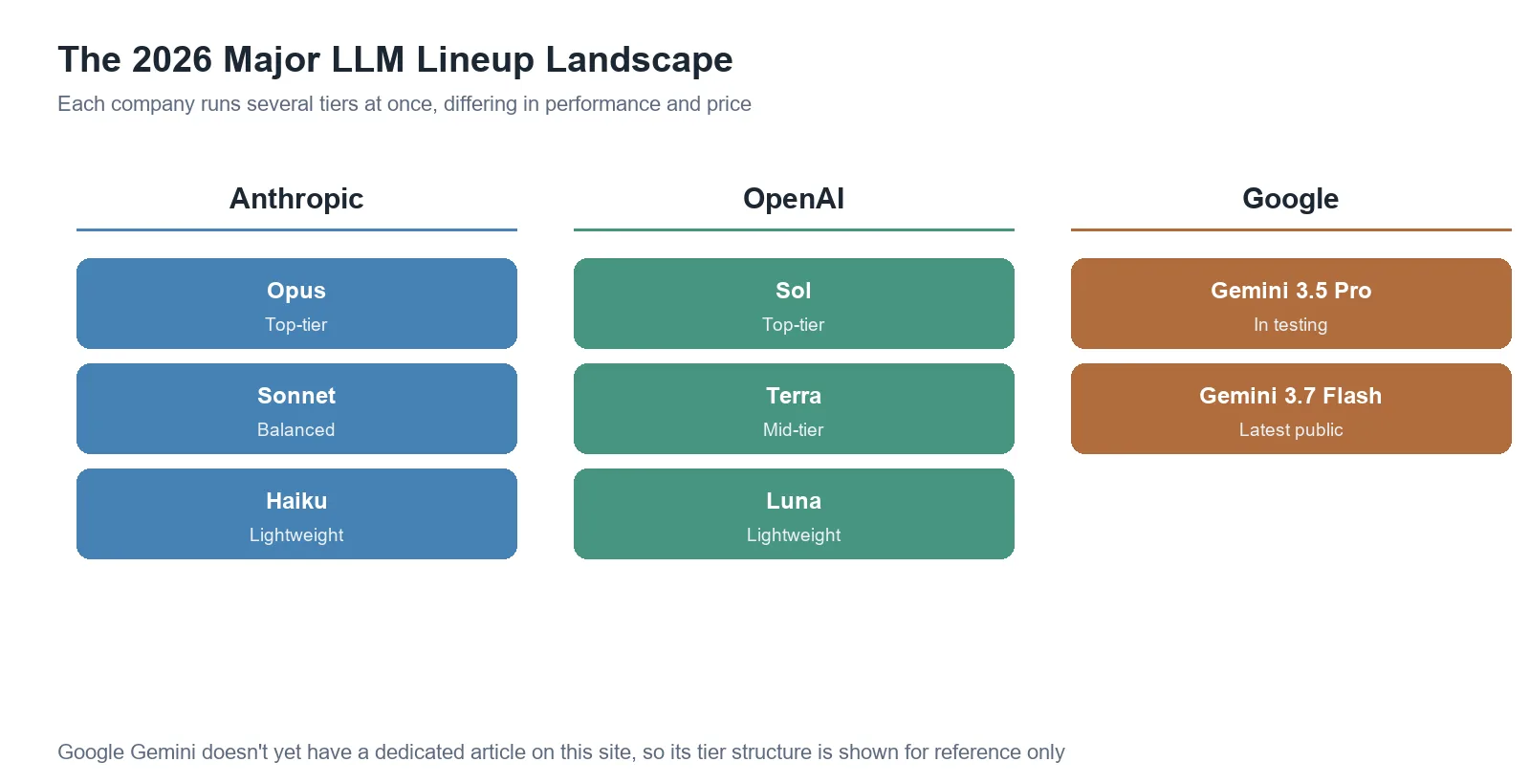
This isn’t a review of any single model — it’s a hub page giving a quick overview of how the major LLM (large language model) families break down as of August 2026, and pointing to this site’s detailed articles on each. Each company now runs several tiers of models at once, so knowing what tiers exist within each family is a useful starting point.
Anthropic — the Claude family
Claude splits into three tiers by performance and price.
| Tier | Role |
|---|---|
| Opus | Top-tier performance, most expensive |
| Sonnet | Balance of performance and price |
| Haiku | Lightest and fastest |
Articles on this site:
Claude is also available as a dedicated coding-agent tool, Claude Code.
OpenAI — the GPT family
Starting with GPT-5.6, OpenAI ships not a single model but three tiers: Luna (lightweight), Terra (mid-tier), and Sol (top-tier).
Articles on this site:
- What Changed in GPT-5.6?
- Coding agent comparison: Claude Code vs ChatGPT (Codex)
Google — the Gemini family
Google runs the Gemini series. As of August 2026, the latest publicly available model is Gemini 3.7 Flash, while the higher-tier Gemini 3.5 Pro has been reported to be in limited partner testing. This site hasn’t yet covered Gemini in a dedicated article — to avoid stating unverified details as fact, that will be added as a separate article later.
Open models you can run yourself, locally
Claude, GPT, and Gemini are all Cloud LLMs that run on their maker’s servers. By contrast, open models like Qwen, DeepSeek, and Llama can be downloaded and run by anyone. Other articles on this site cover how to run these on your own computer.
The technology underlying these models
Claude, GPT, Gemini, and nearly every current LLM are built on a deep learning architecture called the Transformer. If you’re curious how the models themselves work, it’s worth reading the machine learning and deep learning articles first.
Limitations and caveats
- The LLM market moves fast enough that new models can appear every few weeks. This article is a snapshot as of August 22, 2026 — check each model’s detailed article or official documentation for the exact latest specs.
- Models without a dedicated article on this site yet, including Gemini, are intentionally not covered in depth, to avoid stating details without sufficient research and verification.
- Many models beyond those introduced here exist (Llama, Mistral, Qwen, DeepSeek, and others). This hub page focuses on the families this site has already covered and doesn’t attempt to be exhaustive.
Conclusion
The 2026 LLM market has settled into a structure of “each company running a lineup of several tiers,” rather than “one company, one model.” Anthropic (Opus/Sonnet/Haiku) and OpenAI (Sol/Terra/Luna) are the clearest examples — and understanding this structure makes each detailed comparison article much easier to follow.