What Changed in GPT-5.6? Key Features and Use Cases
A rundown of GPT-5.6's three-tier lineup (Luna, Terra, Sol), pricing, and key performance improvements, released by OpenAI in July 2026.
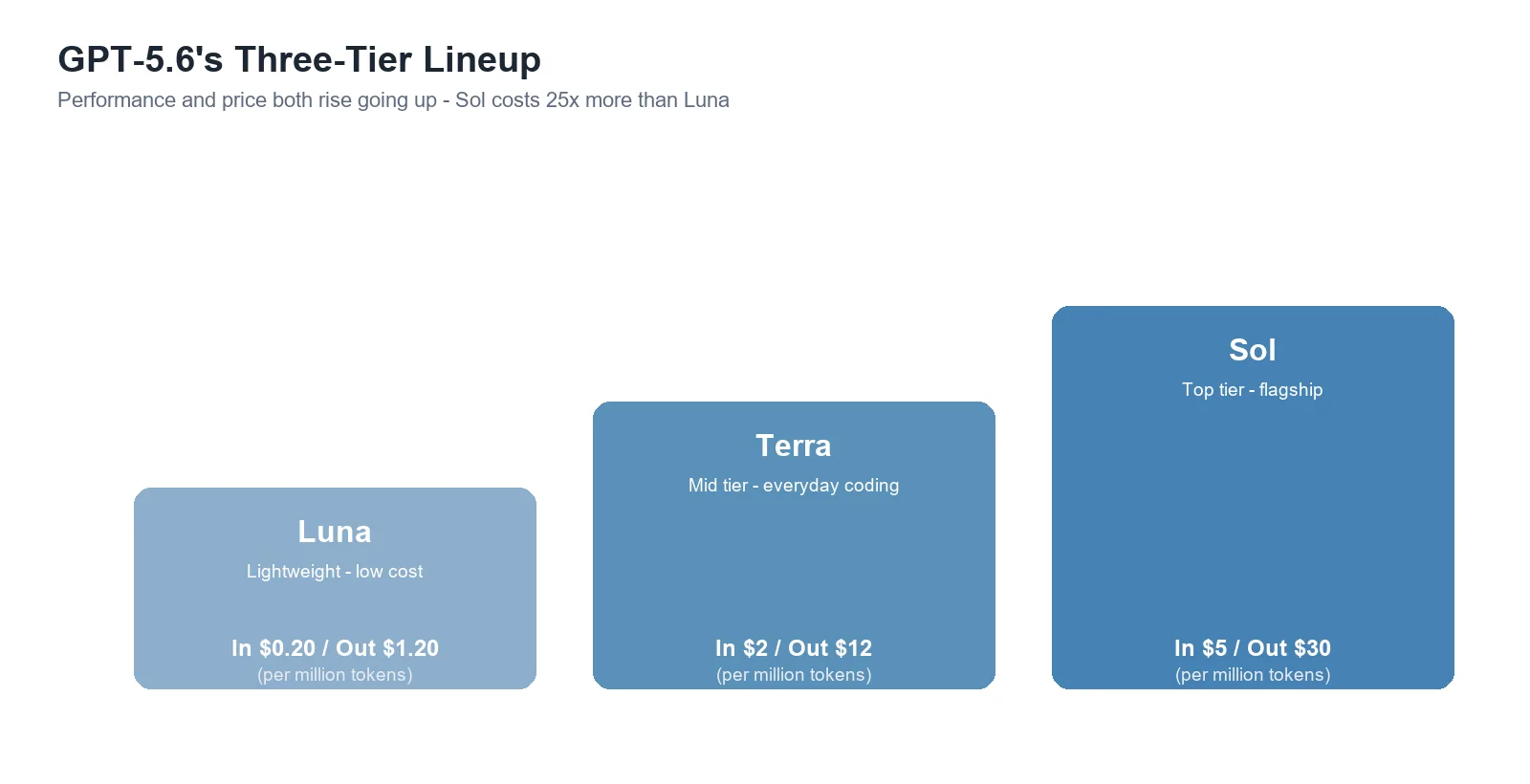
GPT-5.6 (also written GPT 5.6 or GPT5.6) is the model OpenAI formally released on July 9, 2026 — not a single model, but a lineup of three tiers with different performance and pricing: Luna, Terra, and Sol. Where the previous approach was to pick “the one best model,” GPT-5.6 moves closer to a structure where you choose one of three tiers based on task difficulty.
GPT-5.6’s three tiers
| Tier | Positioning | Characteristics |
|---|---|---|
| Sol | Top tier (flagship) | The “most capable coding model,” optimized for complex reasoning and agentic tasks. OpenAI said token efficiency on coding tasks improved 54% over the previous version. |
| Terra | Mid tier | Aims to match the previous generation’s GPT-5.5 performance at roughly 50% lower cost. Suited to everyday coding, reasoning, and agentic tasks. |
| Luna | Lightweight / low-cost | The fastest and cheapest in the lineup. Suited to tasks that don’t need deep reasoning, like classification, intent detection, content moderation, and simple summarization. |
Note: OpenAI’s official announcement page (openai.com) blocked automated web-research tool access at the time this article was researched. The content below relies on secondary sources — Wikipedia, CNBC, and other outlets reporting on OpenAI’s announcement — and pricing was cross-checked against several independent price-aggregation sites that repeatedly confirmed the same figures.
Pricing
On July 30, 2026, OpenAI cut Terra’s price by 20% and Luna’s by 80%, while keeping Sol’s price unchanged. As of when this article was written (2026-08-22), pricing is as follows.
| Tier | Input token price | Output token price |
|---|---|---|
| Sol | $5 / million tokens | $30 / million tokens |
| Terra | $2 / million tokens | $12 / million tokens |
| Luna | $0.20 / million tokens | $1.20 / million tokens |
The price gap between Sol and Luna reaches 25x — meaning choosing the wrong tier for a task can mean paying unnecessarily high costs.
Key performance improvements
OpenAI introduced Sol as “the most capable model yet,” highlighting:
- Coding: on the Artificial Analysis Coding Agent Index v1.1 (an independent benchmark organization’s coding-agent evaluation), Sol in maximum-reasoning mode reportedly scored 80, 2.8 points higher than the Anthropic competitor model it was compared against. However, which Anthropic model was used for comparison isn’t specified, so the exact comparison target is unconfirmed.
- Science and biology: improved performance on science-research-related tasks.
- Cybersecurity: OpenAI described Sol as “the most capable cybersecurity model yet.”
- Speed: a new Sol-exclusive API tier called Ultrafast mode was announced to be up to 14x faster than standard processing.
GPT-5.6 also serves as the underlying model for ChatGPT Work, an enterprise agent service released around the same time.
How to choose in practice
- For simple classification, summarization, or routing tasks, start with Luna. At roughly 1/25th Sol’s cost, it’s well suited to high-volume processing.
- For everyday coding and reasoning tasks, Terra is the sensible default — it was built to match the previous generation’s top-tier performance at half the price.
- For complex multi-step agentic work, or hard coding and research tasks, use Sol. If speed is especially important, Ultrafast mode is worth considering alongside it.
This three-tier structure is conceptually similar to how Anthropic splits its models into Opus, Sonnet, and Haiku. The difference is that GPT-5.6 released all three tiers of a single model generation simultaneously. Anthropic’s latest model lineup is covered in Claude Sonnet 5.
Limitations and caveats
- Without direct access to OpenAI’s official announcement page, this article relies on secondary sources (Wikipedia, press coverage) and cross-checked pricing-aggregation sites. Verify the latest figures against OpenAI’s official documentation before adopting it in practice.
- At initial release, some reports indicated it was first made available only to a small set of trusted partners due to government-related restrictions — this was later relaxed, leading to general availability on July 9, 2026.
- Benchmark scores (like the coding-agent index) reflect a specific evaluation organization’s methodology and may differ from real-world perceived performance.
Conclusion
GPT-5.6 is best understood not as “a single model” but as a three-tier performance-price lineup: Luna, Terra, and Sol. The most efficient way to use GPT-5.6 is to split usage by tier — Luna for cost-sensitive bulk work, Terra for everyday development work, and Sol for the hardest tasks.