What Is Multimodal AI? Understanding Text, Images, and Audio Together
How multimodal AI lets a single model understand text, images, audio, and video at once, and the shared embedding space that makes it possible.
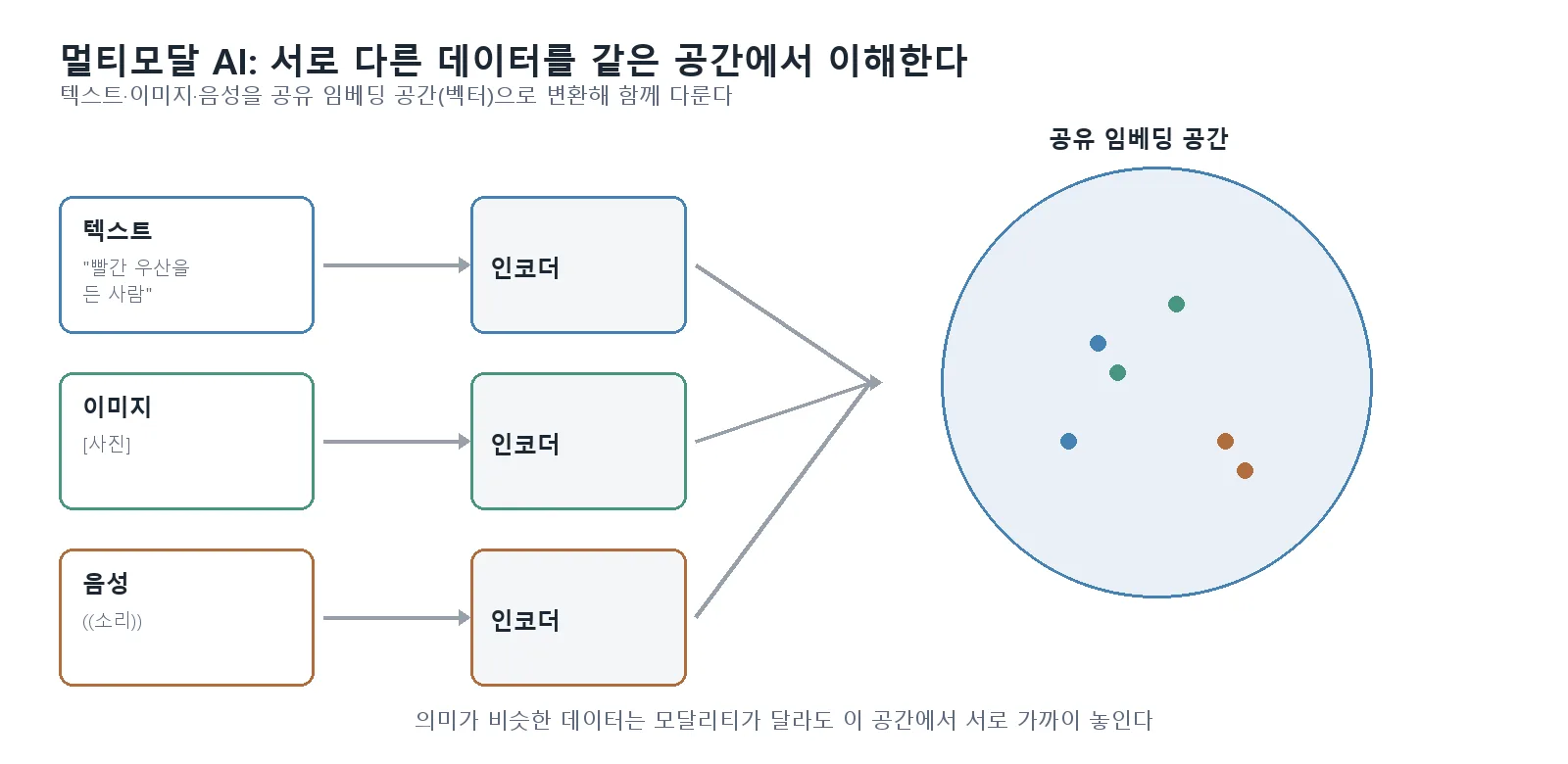
Multimodal AI refers to AI that understands different kinds of data — text, images, audio, video — within a single model, moving between one form and another as needed. Show it a photo and it can describe it in words, or feed it a written description and it can generate an image from it. Where a Vision Language Model (VLM) is a specific model type focused on the image-plus-text combination, multimodal AI is the broader concept that also extends to audio and video.
How it differs from earlier AI
Most earlier AI models were built to handle just one modality — text-only, or image-only. Multimodal AI’s key idea isn’t stitching those separate models together, but building a way to understand different kinds of data through the same underlying representation.
How it understands them together: a shared embedding space
Multimodal AI can handle several kinds of data at once because it converts text, images, and audio into the same numerical vector space — a shared embedding space.
- A modality-specific encoder turns text, images, and audio each into their own vectors.
- These vectors are trained to land in one shared space — text and images pointing at similar meanings end up close together in that space.
- An attention mechanism compares tokens from one modality against tokens from another, linking the relationships between them.
This structure is what lets text like “a person holding a red umbrella” naturally connect with an image actually depicting that scene, inside the vector space.
Where it’s used
- Image captioning and search: generating a description from a photo, or searching for an image using a text query
- Voice assistants: answering a spoken question with a response that mixes text and images
- Understanding documents and charts: reading a document with tables and graphs directly as an image and summarizing its content
- Physical AI: a robot understanding camera (vision) and microphone (audio) input together to act appropriately
How multimodal AI relates to nearby concepts
| Concept | Scope |
|---|---|
| Multimodal AI | AI broadly handling multiple modalities together — text, image, audio, video, and more |
| Vision Language Model (VLM) | A model specialized in exactly two modalities: image and text |
| RAG | Retrieves external documents to inform an answer — increasingly extending into multimodal RAG that handles documents mixing images and tables |
Limitations and caveats
- Adding more modalities increases both the training data and the compute required.
- An answer that looks accurate within one modality can become inaccurate once combined with another (e.g., correctly recognizing an image but describing it incorrectly in words), so checking consistency across modalities matters.
- This article is an introductory conceptual overview and doesn’t cover the specific benchmark performance of any particular multimodal model.
Conclusion
Multimodal AI connects different kinds of data through one shared vector space, letting a model understand and generate across text, images, and audio. VLMs are the leading example specialized in the image-text combination, and the scope keeps expanding to include audio and video.