What Is a Vector Database? How It Differs From a Regular Database
How a Vector Database searches data by meaning rather than exact match, centered on the concepts of Embedding and similarity search.
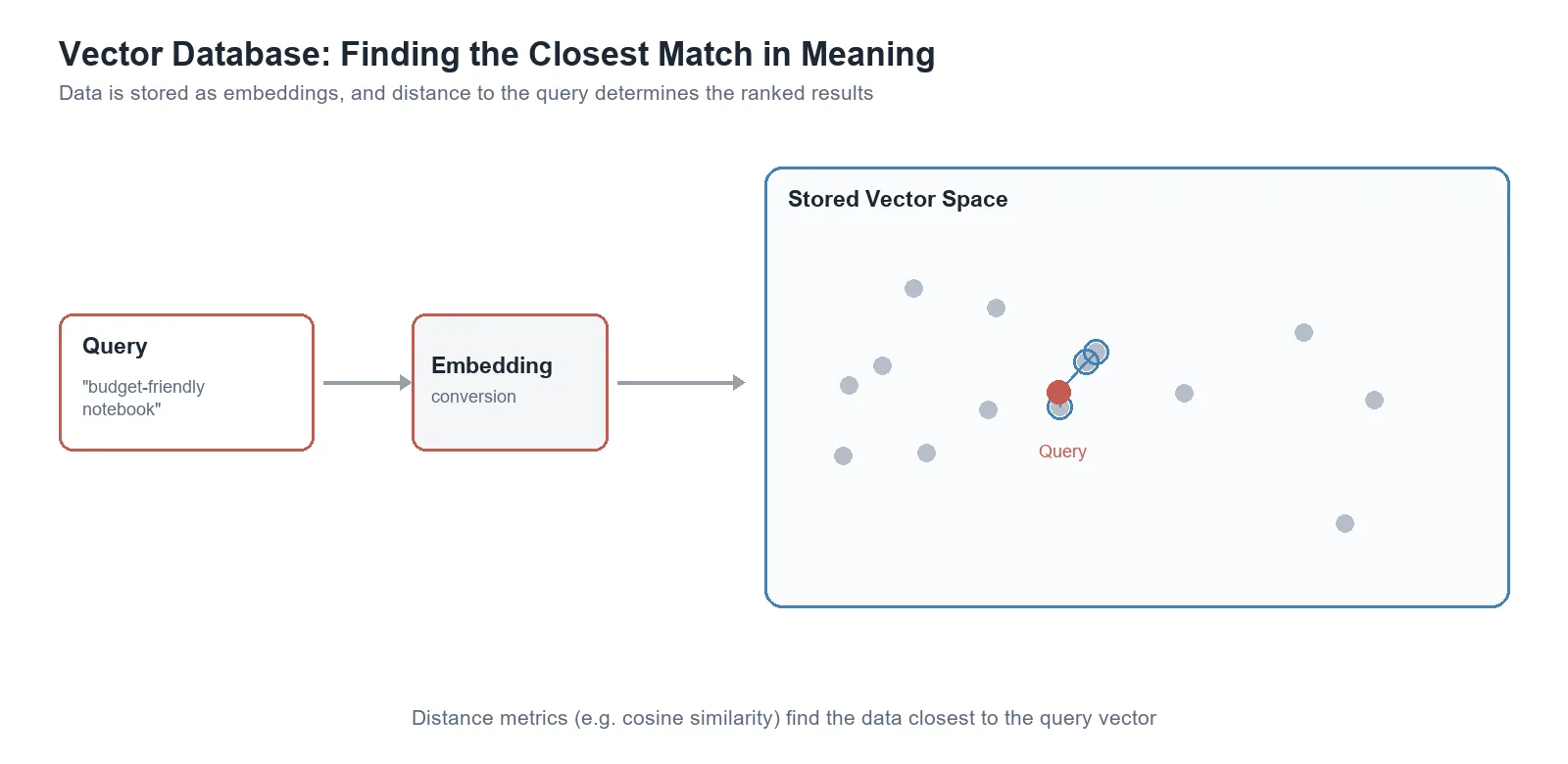
A Vector Database converts data such as text and images into numerical vectors (embeddings) and stores them, then retrieves not “exact matches” but “the closest matches in meaning.” In the structure where RAG retrieves external documents to feed into an LLM’s answer, the Vector Database is the storage layer that actually performs that “retrieval.”
How it differs from a regular database
| Regular Database | Vector Database | |
|---|---|---|
| Search method | Exact match lookup | Similarity search — closest in meaning |
| What it stores | Structured values (numbers, strings, etc.) | Embedding vectors capturing a data point’s meaning |
| Suited for | “What is the record with this ID?” | “Which document is closest in meaning to this sentence?” |
For example, searching “affordable laptop recommendation” in a regular database only returns records that literally contain that phrase. A Vector Database converts the sentence into an embedding and also surfaces data that’s worded differently but similar in meaning, such as “budget-friendly notebook.”
Embedding: turning meaning into numbers
An embedding converts data such as text, images, or audio into coordinates (a numerical vector) in a high-dimensional space. Data with similar meaning ends up positioned close together in that space. A Vector Database stores vectors built this way, and at search time converts the query into a vector the same way, then compares its distance to the stored vectors.
How similarity search works
A Vector Database measures how close vectors are using distance metrics such as cosine similarity or Euclidean distance. As the number of stored vectors grows, computing the exact distance to every single one becomes slow, so in practice Approximate Nearest Neighbor (ANN) algorithms such as HNSW and IVF trade a small amount of accuracy for a large gain in search speed.
Where it’s used
- RAG: finding document chunks similar in meaning to a question and passing them to the LLM together
- Recommendation systems: recommending “products similar to this one”
- Image and audio search: finding a desired image via text, or finding similar sounds
- Multimodal AI: searching different modalities such as text and images together within the same vector space
Limitations and caveats
- Approximate Nearest Neighbor algorithms trade off some accuracy for speed, so they don’t guarantee returning only the truly closest results.
- Embedding quality (which model produced the vectors) heavily determines search quality — even a good Vector Database returns inaccurate results if the embeddings themselves are weak.
- Memory and compute costs both rise as the vector dimensionality and the amount of stored data increase.
Conclusion
A Vector Database is a storage layer that lets data be searched by “how similar it is in meaning” rather than “whether it exactly matches,” and it’s the component that actually powers the retrieval step behind RAG and many other AI applications. Its core lies in two steps: vectorizing data through embeddings, and finding the closest results through similarity search.