What Is Claude Sonnet 5? What Changed from Sonnet 4.6
How Claude Sonnet 5, released by Anthropic in June 2026, differs from its predecessor Sonnet 4.6 in price, performance, and features, based on the official announcement.
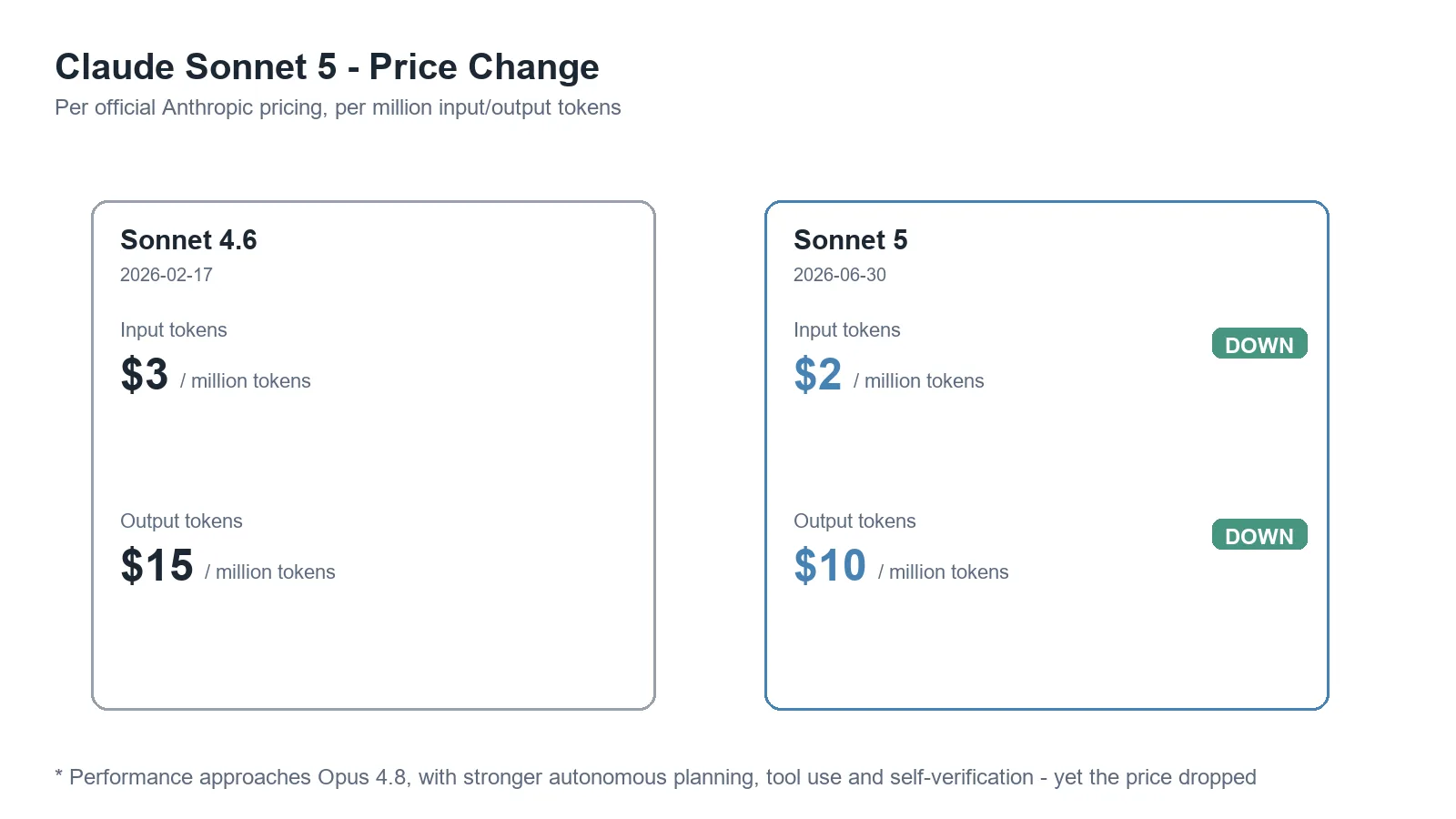
Claude Sonnet 5 is Anthropic’s mid-tier model released on June 30, 2026 — the headline change is that it costs less than its predecessor Sonnet 4.6 while pushing autonomous task performance (agentic capability) higher. Anthropic introduced it as “the most agentic Sonnet yet,” built to deliver performance close to the high-end Opus 4.8 at a lower price.
This article summarizes, based on the official announcement, exactly what Claude Sonnet 5 is, how it differs from the previous version, and when to choose which model — written to be understandable even for readers new to AI models.
What is Claude Sonnet 5
Claude is Anthropic’s family of conversational AI (LLM, Large Language Model) products. Anthropic offers models across three tiers by performance and price: the most powerful and expensive is Opus, the mid-tier that balances performance and price is Sonnet, and the lightest and fastest is Haiku. Sonnet 5 is the fifth generation of the mid-tier line.
At launch, Sonnet 5 took over as the default model for Claude.ai’s Free and Pro plans from the previous Sonnet 4.6, and is also available on the Max, Team, and Enterprise plans. It’s called via the API using the model name claude-sonnet-5.
What changed from Sonnet 4.6
The most notable change is that the price actually went down. New model generations are usually more expensive, but Anthropic priced Sonnet 5 lower than Sonnet 4.6.
| Item | Sonnet 4.6 (2026-02-17) | Sonnet 5 (2026-06-30) |
|---|---|---|
| Input token price | $3 / million tokens | $2 / million tokens |
| Output token price | $15 / million tokens | $10 / million tokens |
| Context window | 1M tokens (beta) | No figure given in the official announcement |
| Performance positioning | Approaching Opus-tier | Approaching Opus 4.8, at lower cost |
| Highlights | Broad improvements in coding, computer use, and long-form reasoning | Stronger autonomous planning, tool use, and self-verification |
Note: a “token” is the smallest unit of text an AI processes — roughly one English word or part of one. “Input/output token price” refers to the cost per million tokens of text sent to the AI and generated by the AI, respectively.
On features, Anthropic said Sonnet 5 shows significant improvement over Sonnet 4.6 in reasoning, tool use, coding, and knowledge work. Specific changes highlighted include:
- Stronger autonomous planning and tool use: improved ability to judge for itself when to use tools like a browser or terminal.
- Longer autonomous task execution: it can carry complex, multi-step tasks through to completion without human intervention where earlier Sonnet models might have stalled partway through.
- Self-verification: it checks its own results more often without being explicitly told to.
- More cost-performance options: finer-grained performance tiers to choose from compared to Sonnet 4.6.
- Safety: Anthropic said the rate of undesirable behavior is generally lower than Sonnet 4.6, though in specific areas like developing cybersecurity exploits it performs noticeably below Opus 4.8.
What changes in practice
For everyday users, the practical impact boils down to two things.
- You get a smarter default model on the same plan. Free and Pro users are switched to Sonnet 5 automatically, with no setup required.
- Costs drop if you use the API or developer tools like Claude Code. For the same task, the lower per-token price means automated workloads cost less than before.
On the other hand, if a task genuinely needs Opus-tier top-end performance (very hard research, large-scale refactoring), it’s worth comparing whether Sonnet 5 is sufficient or the higher-tier Opus 5 is needed. That judgment call is covered in more detail in Claude Opus 5 vs Sonnet 5.
Limitations and caveats
- Anthropic’s official announcement doesn’t state Sonnet 5’s context window size (how much text it can process at once). Unlike Sonnet 4.6, which had a 1M-token beta context window, Sonnet 5’s exact figure hasn’t been confirmed, so check the API documentation before relying on it in a real project.
- Pricing and model availability can keep changing under Anthropic’s policies. The prices in this article were confirmed as of August 22, 2026.
- The phrase “performance approaching Opus 4.8” is based on Anthropic’s own evaluations; actual perceived performance can vary by task type.
Conclusion
Claude Sonnet 5 is an upgrade in the direction of “cheaper and more autonomous.” Where Sonnet 4.6 focused on raising coding and computer-use ability broadly, Sonnet 5 adds agentic performance — carrying complex tasks through without human intervention — while also improving cost efficiency. If you’re already on Claude Free or Pro, you’ll be switched to Sonnet 5 automatically with no action needed, and API or Claude Code users will notice the lower per-token price.