Claude Opus 5 vs Sonnet 5: Which Model Is Better for Claude Code?
Comparing Anthropic's top-tier Opus 5 and mid-tier Sonnet 5 on price, performance, and use case, and which model fits which kind of task.
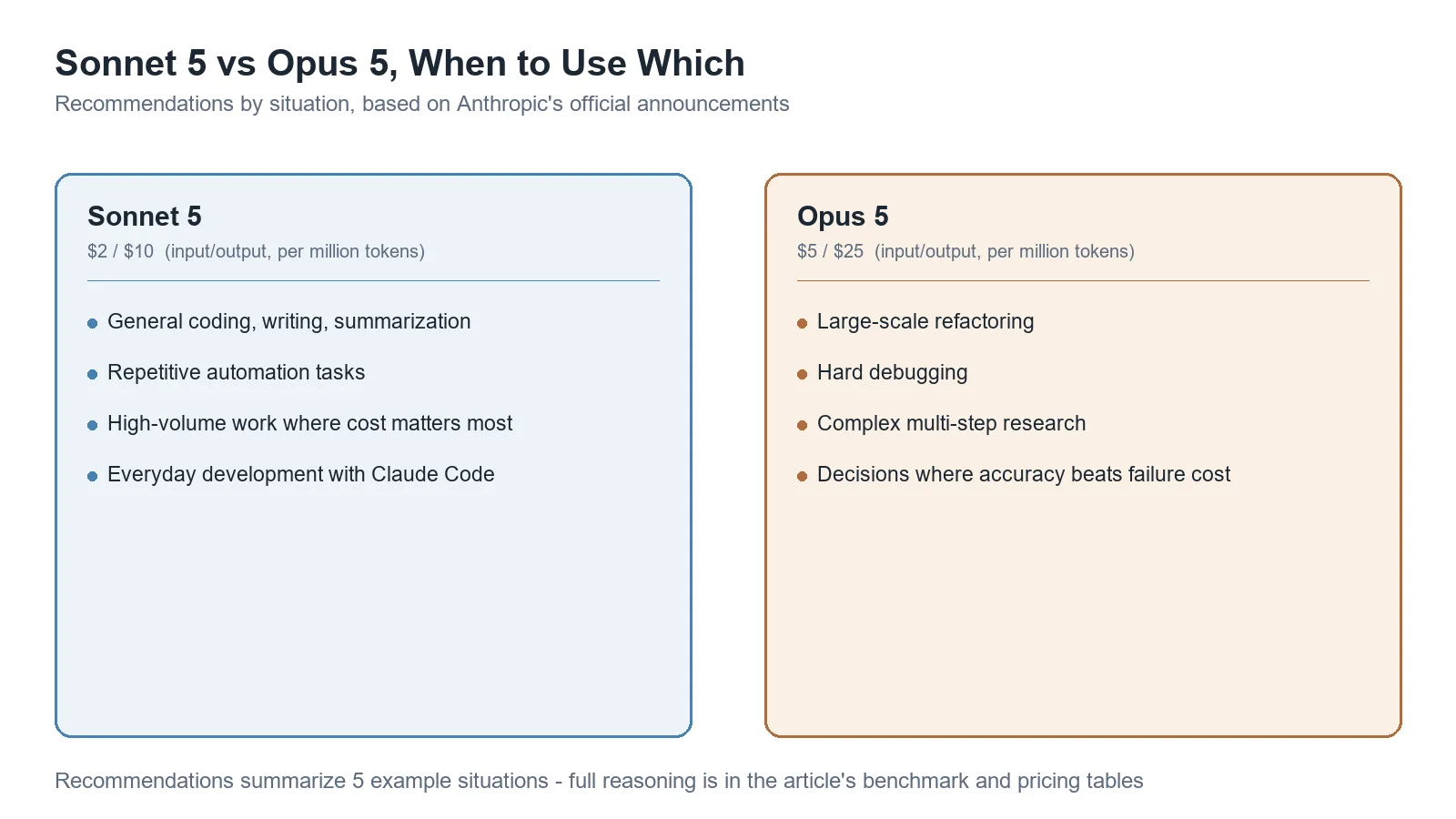
Claude Opus 5 is the “most powerful” model, and Sonnet 5 is the “most balanced.” Both are current-generation models released in 2026, but Anthropic’s stated price gap between them is 2.5x — Opus 5 runs $5 per million input tokens versus $2 for Sonnet 5. This article summarizes, based on both models’ official announcements, which situations call for which model.
First, why does Anthropic split models into tiers
The reason Anthropic doesn’t offer a single top-end model is simple: not every task needs maximum performance. Using a top-tier model for a simple code edit is slower and more expensive than it needs to be. So Anthropic splits models into Opus (top tier), Sonnet (mid tier), and Haiku (lightweight), letting users pick a model that matches task difficulty. Opus 5 and Sonnet 5 — released July 24 and June 30, 2026, respectively — are this generation’s top two tiers.
Price and positioning compared
| Item | Sonnet 5 | Opus 5 |
|---|---|---|
| Release date | 2026-06-30 | 2026-07-24 |
| Input token price | $2 / million tokens | $5 / million tokens |
| Output token price | $10 / million tokens | $25 / million tokens |
| Anthropic’s positioning | “Performance approaching Opus 4.8, at a lower price” | “Fable 5-class intelligence at Opus-level speed and cost” |
| Fast mode | Not mentioned | 2x base price (speed-prioritized) |
On price alone, Opus 5 costs 2.5x more than Sonnet 5 for both input and output. In exchange, Anthropic says Opus 5 delivers “more than double the performance at a lower cost per task” versus the previous-generation Opus 4.8 on a software-engineering benchmark (Frontier-Bench), and scored 3x higher than the next-best model on a complex problem-solving benchmark (ARC-AGI 3).
Actual performance differences: what’s confirmed and what isn’t
Reviewing Anthropic’s official announcements for each model, the following can be confirmed.
- Opus 5’s confirmed strengths: software engineering (Frontier-Bench), complex problem-solving (ARC-AGI 3), life sciences (a 10.2-point improvement over Opus 4.8 on organic-chemistry-related tasks), and computer use (ahead of the top-tier Fable 5 at lower cost on OSWorld 2.0).
- Sonnet 5’s confirmed strengths: improved autonomous planning, tool use, and self-verification; a lower price than Sonnet 4.6; more fine-grained cost-performance options.
- What Opus 5’s announcement says: it states that Opus 5 “outperforms Sonnet 5 on most evaluations,” but no official benchmark table directly comparing the two models item-by-item has been published. So any claim of “exactly how many percent better” is left as unconfirmed.
In other words, Anthropic’s announcements confirm that Opus 5 is generally more powerful, but the exact gap can vary by task type and isn’t precisely knowable from official materials alone.
Effort Dial: even the same model can be tuned in intensity
Both models offer an “Effort” level setting. In practice, this means the same model can be told to answer “fast and cheap” or “slower but with deeper thinking.” Anthropic says Opus 5’s performance shifts along this dial between prioritizing intelligence (accuracy) and prioritizing token savings (speed/cost). So whether “Opus 5 at low effort” or “Sonnet 5 at high effort” is better can depend on the task.
When to choose which model
| Situation | Recommendation |
|---|---|
| General coding, writing, summarization, repetitive automation | Sonnet 5 |
| Large-scale refactoring, hard debugging, complex multi-step research | Opus 5 |
| High-volume processing where cost matters most | Sonnet 5 (low effort if needed) |
| Tasks where accuracy matters far more than failure cost (e.g. assisting important decisions) | Opus 5 |
| Automating everyday development work with Claude Code | Start with Sonnet 5, switch to Opus 5 only for tasks that get stuck |
A common strategy in practice is to default to Sonnet 5 and switch to Opus 5 only when Sonnet 5 repeatedly fails or the task is especially complex. Since Anthropic makes both models available identically across Claude Code, the API, and Claude.ai, switching itself is straightforward.
Limitations and caveats
- All benchmark figures in this article come from Anthropic’s own published materials, not independent third-party verification.
- Prices are as of August 22, 2026, and may change afterward.
- There’s no official material directly comparing both models under identical conditions, so this article’s comparison table simply lays each model’s individual announcement side by side. The most accurate way to gauge the real difference for a specific task is to test it directly.
Conclusion
Sonnet 5 is the “powerful enough and affordable” default choice, while Opus 5 is the higher-end option for situations where accuracy matters more than cost. Both are current-generation models released in summer 2026, and both show a general performance gain over their predecessors (Sonnet 4.6, Opus 4.8) — but the precise gap between the two models is best checked directly, task by task.