What Is Machine Learning? Understanding Its Place Within AI
How AI, machine learning, and deep learning relate to each other, and how machine learning learns rules on its own from data.
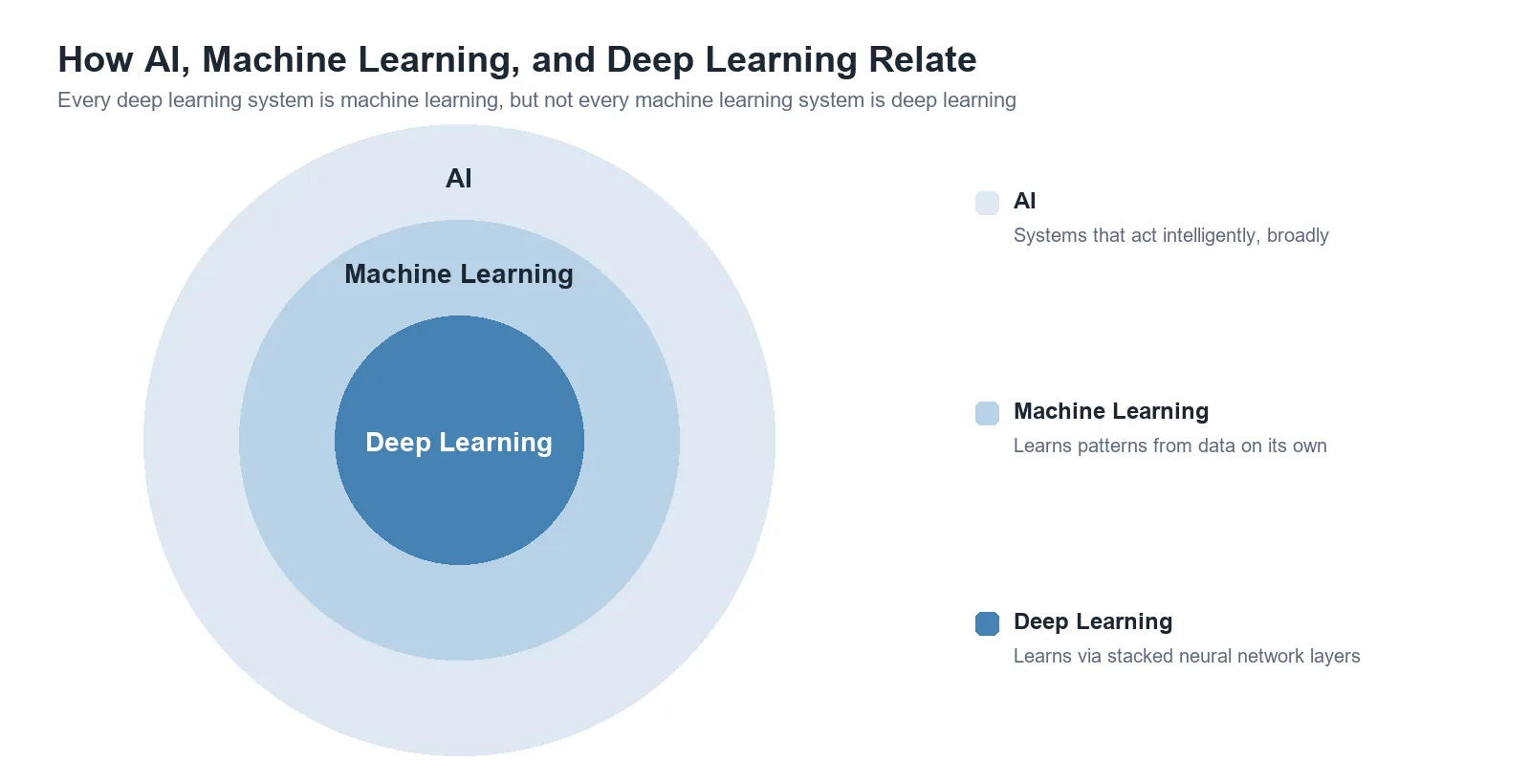
Machine learning is a branch of artificial intelligence (AI) that learns patterns from data on its own, without a person hand-coding every rule, in order to predict or decide. “AI” is the broadest concept, machine learning is one branch within it, and deep learning is a narrower branch within machine learning.
How it differs from traditional programming
Traditional programming has a person write code that says “given this input, do this.” Machine learning works the other way — instead of a person designing the rules, showing the computer a lot of input-and-answer data lets it find the rules (patterns) on its own. For example, to filter spam email, the traditional approach requires manually defining rules like “if it contains this word, it’s spam,” while machine learning trains on many spam/legitimate email examples and lets the computer discover the criteria itself.
How AI, machine learning, and deep learning relate
AI
 └─ Machine Learning
└─ Deep Learning- AI is the broadest term, referring to “systems that act intelligently, the way a person would.”
- Machine learning refers specifically to the “learns from data” approach within that.
- Deep learning is the branch of machine learning that learns by stacking artificial neural networks — modeled on the brain’s neural structure — into many layers.
In other words, every deep learning system is machine learning, but not every machine learning system is deep learning.
Characteristics of machine learning
- Works well even on small-to-medium structured data (table-shaped data).
- Can often be trained on a regular CPU with relatively little memory.
- Trains quickly, which makes it good for fast iterative experimentation.
- Often still requires a person to manually select and engineer which features matter for prediction (feature engineering).
- Results are often easier to interpret, which makes it a good fit for fields where explaining “why it decided this” matters (credit scoring, fraud detection, etc.).
Common applications
- Fraud detection (e.g. credit card misuse)
- Credit scoring and loan underwriting
- Demand and sales forecasting
- The foundational algorithms behind recommendation systems
These use cases tend to involve relatively structured data and often require explainable reasoning, which is why machine learning remains widely used for them.
Limitations and caveats
- In practice, the terms “machine learning” and “deep learning” are sometimes used interchangeably. This article draws a conceptual distinction for clarity, but not all sources follow it strictly.
- Machine learning tends to fall relatively behind deep learning as unstructured data (images, text, audio) gets larger and more complex.
Conclusion
Machine learning is the core AI approach of “letting the system learn from data on its own, instead of a person defining the rules.” It remains strong for problems involving structured data and where explainability matters, while for more complex unstructured data like images and text, deep learning — covered in the next article — tends to be the tool of choice.