What Is Deep Learning? How It Differs from Machine Learning
How deep learning stacks artificial neural networks in layers to learn unstructured data like images and text, and how it practically differs from machine learning.
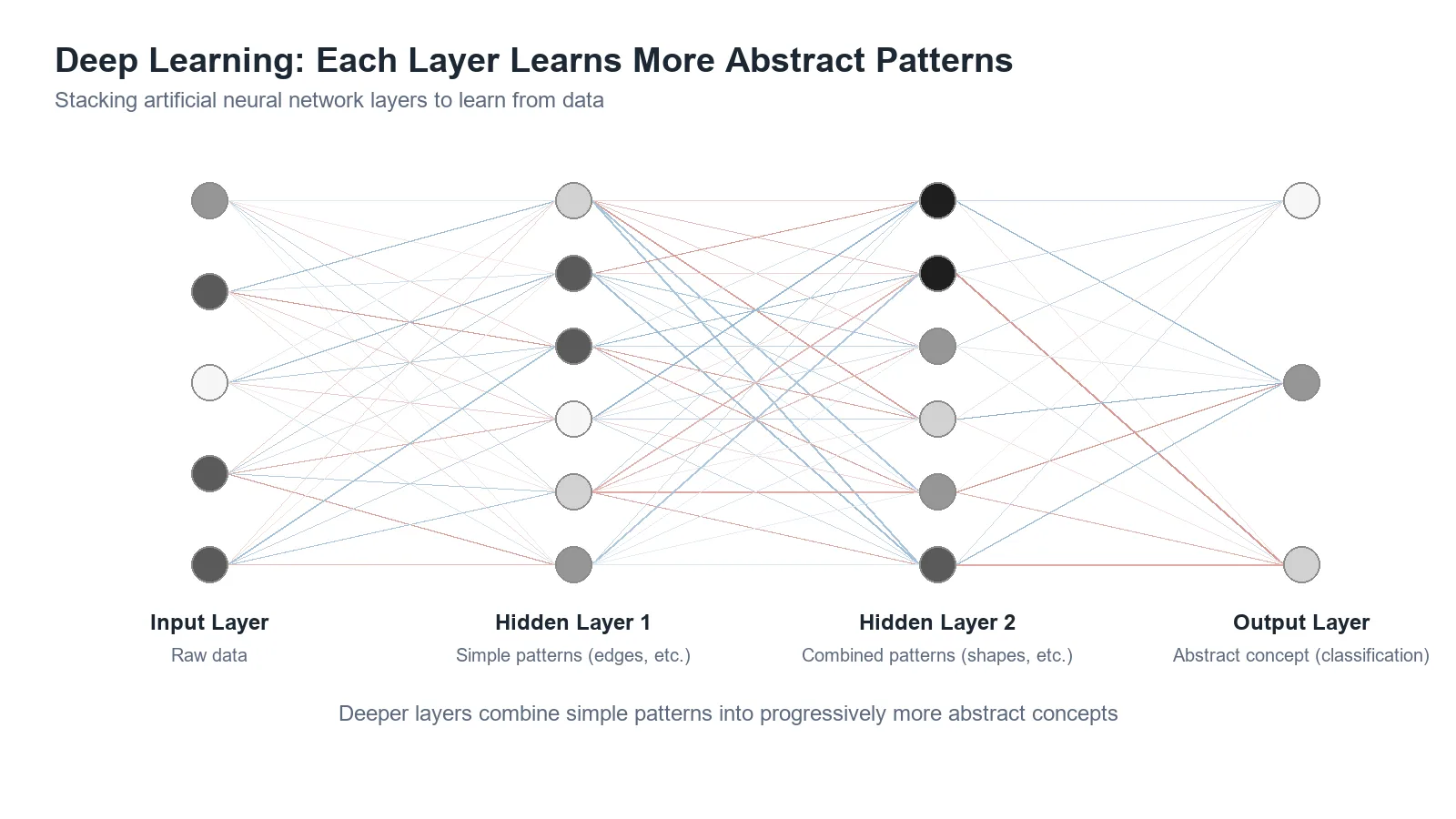
Deep learning is a branch of machine learning that learns from data by stacking artificial neural networks — modeled loosely on the connected neurons of the human brain — into many deep layers. The name “deep” comes from having many such layers stacked on top of each other. Most LLMs and object detection/segmentation models covered on this site are built on deep learning.
The practical difference from machine learning
| Machine Learning | Deep Learning | |
|---|---|---|
| Data it handles well | Small-to-medium structured data (tables) | Large volumes of unstructured data (images, text, audio) |
| Feature engineering | Often designed manually by a person | The network learns features automatically |
| Compute needed | Often fine on a regular CPU | Usually needs high-performance hardware like a GPU/TPU |
| Training time | Relatively fast | Can take much longer as the network gets more complex |
| Interpreting results | Relatively easy to interpret | Often hard to explain “why” it decided something (black-box nature) |
Why deep learning excels at images and text
Traditional machine learning required a person to manually design “what features to look at in this image.” Deep learning lets the network learn this process itself — the first layer picks up very simple patterns (like edges), the next layer combines those into slightly more complex patterns (shapes), and later layers recognize even more abstract concepts (object types), automatically extracting increasingly abstract features as data passes through more layers. This automation is what gives it an edge on complex data like images or natural language, where it’s hard for a person to hand-write all the rules.
Deep learning applications covered on this site
- LLMs (Large Language Models): models like Claude Sonnet 5 and GPT-5.6 are built on a deep learning architecture called the Transformer.
- Object detection and segmentation: YOLO and SAM use deep neural networks to find objects in an image and delineate their boundaries.
- Physical AI: how a robot perceives its surroundings through a camera also mostly relies on deep-learning-based computer vision models.
Common neural network architectures (terms only)
- CNN (Convolutional Neural Network): an architecture strong at image processing, used for object recognition, image classification, and more.
- Transformer: an architecture that processes relationships between words in a sentence in parallel; most LLMs today are built on this structure.
The detailed mechanics of each architecture can be covered more deeply in a dedicated article.
Limitations and caveats
- Deep learning needs large amounts of data and compute (GPUs) to train, so for problems with little data or where explainability matters, traditional machine learning can actually be the better fit.
- Its “black-box” nature often makes it hard to explain why a particular result came out — a real practical constraint in fields like healthcare or finance where the reasoning behind a decision matters.
- This article is an introductory conceptual overview and doesn’t cover the mathematical details (backpropagation, loss functions, etc.) needed for actual implementation.
Conclusion
Deep learning is a branch of machine learning that stacks artificial neural networks deeply to learn patterns from complex unstructured data like images and text, without a person having to hand-write the rules. Most of the LLM and computer vision models covered on this site are built on deep learning, making this concept a useful starting point for understanding the other articles more deeply.