SAM vs. YOLO: Comparing Segmentation and Detection
YOLO and SAM solve different problems in computer vision. Here's how they compare, and when to reach for each one.
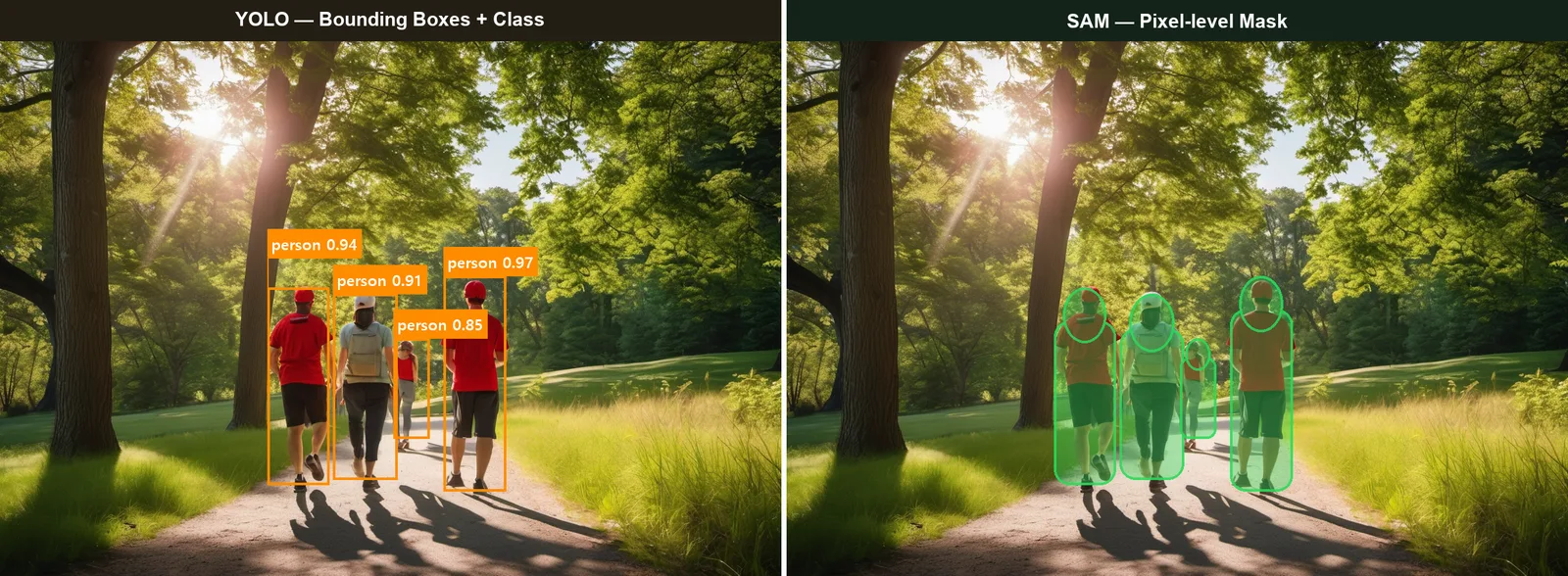
YOLO is an object detection model that quickly locates objects in an image with rectangular bounding boxes; SAM (Segment Anything Model) is a segmentation model that finds an object’s precise pixel boundary. They aren’t competitors — they’re designed to solve different problems, and in practice they’re often used together.
YOLO: Fast Object Detection
YOLO (You Only Look Once) processes an image in a single forward pass to predict both an object’s location (bounding box) and its class simultaneously — a real-time object detection model. Ultralytics and others continue to release successive versions, and it’s widely used wherever real-time speed matters: CCTV analysis, driver-assistance systems, industrial inspection.
YOLO’s output is essentially “there’s a person in this rectangle” — it doesn’t tell you the person’s precise outline.
SAM: General-Purpose Segmentation
SAM (Segment Anything Model), released by Meta AI Research, predicts an object’s pixel-level boundary (mask) from a point click, a box, or a text prompt. Its defining trait is generality — it can segment a wide range of objects without being trained on specific classes in advance, close to zero-shot segmentation.
SAM’s output answers “where is this object’s exact outline” — classifying what the object is isn’t its primary goal.
Update (2026-08-22): On August 4, 2026, Meta released SAM 3 (also written SAM3, Promptable Concept Segmentation), which finds and tracks every instance matching a “concept” specified via text or image examples. Its predecessor, SAM 2 (SAM2), extended segmentation from still images to video, tracking objects across frames. Where earlier SAM versions focused on segmenting a single object from a point or box prompt, SAM 3 can process multiple instances at once at the concept level — something like “person wearing a red baseball cap.” See News: Meta Releases Concept-Based Segmentation Model SAM 3 for details.
Comparison Table
| YOLO | SAM | |
|---|---|---|
| Problem type | Object detection | Segmentation |
| Output | Bounding box + class | Pixel-level mask |
| Speed | Near real-time | Relatively heavier, depending on model/config |
| Class awareness | Detects only trained classes | Segments regions without classification |
| Typical use | Real-time detection, counting, tracking input | Precise masking, data labeling, editing tools |
Using Them Together
In practice, the two models are often chained into a pipeline: YOLO quickly locates an object (a box), and that box is passed to SAM as a prompt to get a precise mask. This is far more efficient than running SAM indiscriminately over an entire image — it lets you segment only the region you actually care about.
Limitations and Caveats
- YOLO generally can’t detect classes it wasn’t trained on.
- SAM doesn’t tell you what an object is, so classification requires pairing it with another model.
- Speed, accuracy, and license terms vary by version for both models — check the official repository’s current license and benchmarks before adopting either in production.
Conclusion
YOLO and SAM answer two different questions: “where is what” (detection) and “exactly where does this object end” (segmentation). Rather than choosing one over the other, the right call depends on whether your project needs fast detection, precise boundaries, or both — and combining them is often the most practical answer.