What Is Depth Anything? Estimating Depth From a Single Photo
How Depth Anything, a monocular depth estimation model, predicts per-pixel relative distance from just one image taken with a single camera.
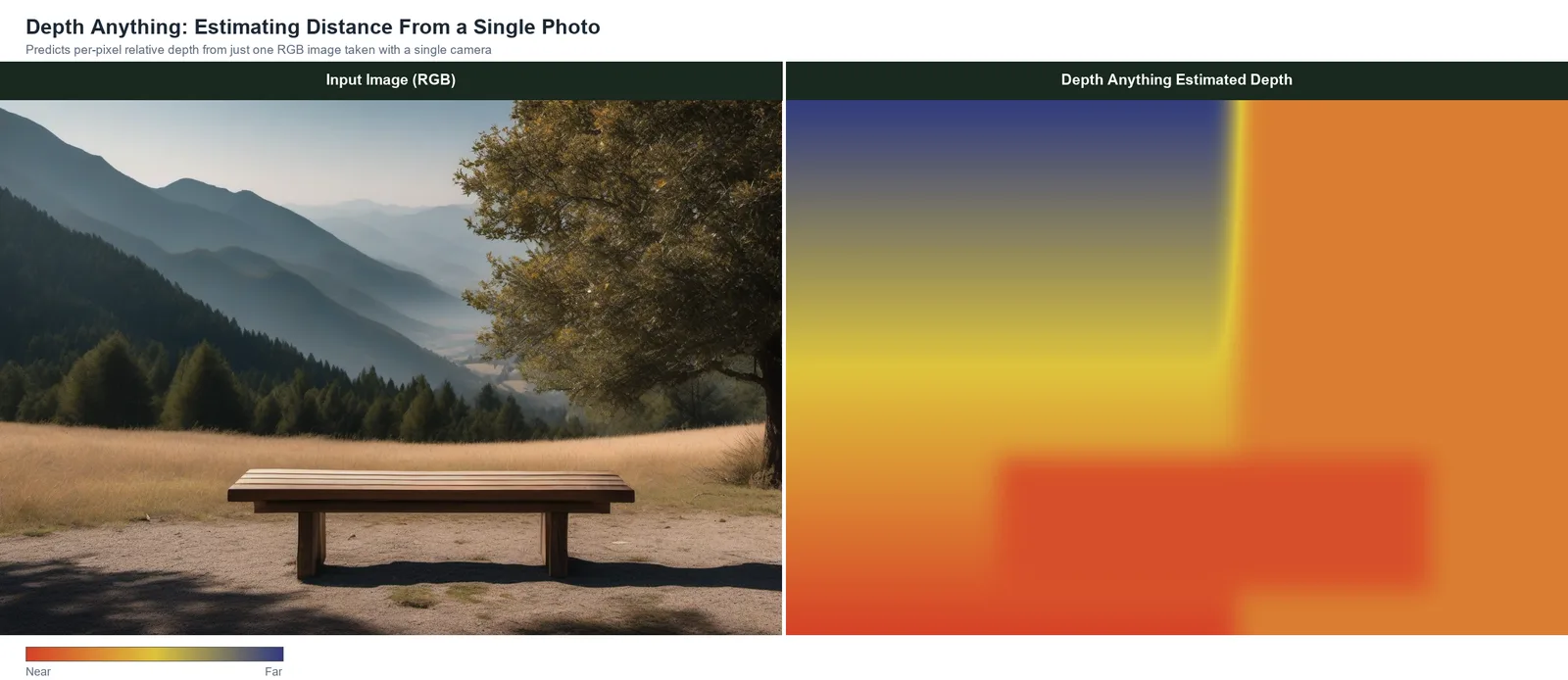
Depth Anything is a monocular depth estimation model that predicts per-pixel relative distance (depth) from a single image taken with one camera. Where Stereo Vision triangulates depth from the disparity between two camera views, Depth Anything needs only a single camera and a single image to predict which pixels are closer or farther relative to each other.
How it estimates depth from just one photo
Depth Anything (V2) is trained with a teacher-student framework.
- A large teacher model based on DINOv2-Giant is first trained exclusively on about 595,000 labeled synthetic images.
- That teacher model then generates pseudo depth labels for over 62 million real, unlabeled photos.
- The final student models are trained on this large volume of automatically pseudo-labeled real-world data.
This approach produces a model that’s robust on real photos without requiring a human-labeled real-world depth dataset. The architecture itself is a Vision Transformer-based design built on DINOv2, with some modifications to the decoding stage.
Model sizes and licenses
| Model | Parameters | License |
|---|---|---|
| Small | ~24.8M | Apache-2.0 |
| Base | ~97.5M | CC-BY-NC-4.0 |
| Large | ~335.3M | CC-BY-NC-4.0 |
| Giant | ~1.3B | CC-BY-NC-4.0 |
Only the smallest Small model is released under the commercially permissive Apache-2.0 license; the rest are restricted to non-commercial use under CC-BY-NC-4.0.
How it differs from earlier approaches
Before Depth Anything, models such as Marigold and GeoWizard estimated depth using Stable Diffusion-based architectures. According to the official project page, Depth Anything (V2) runs more than 10x faster than these diffusion-based approaches while producing more fine-grained depth boundaries and higher accuracy with fewer parameters.
Where it’s used
- 3D reconstruction: recovering an approximate 3D structure from just photos or video
- Augmented reality (AR): placing virtual objects naturally requires knowing the depth of the real space
- Robotics and Physical AI: judging distance to obstacles from camera footage alone, without a dedicated depth sensor
- Photo editing: applying background blur (bokeh) effects by separating subject from background based on distance
Limitations and caveats
- The depth Depth Anything estimates is relative depth — without further calibration, it doesn’t give an absolute distance value like “exactly N meters” (though separate metric-depth variants are provided for indoor and outdoor use).
- Unlike Stereo Vision, which computes depth from actual camera geometry, this is a value estimated from training data, so error can grow on scenes that differ significantly from what the model was trained on.
- Models at Base size and above use a non-commercial license (CC-BY-NC-4.0), so license terms must be checked carefully before commercial use.
Conclusion
Depth Anything uses large-scale teacher-student pseudo-labeling to make practical depth estimation possible from a single photo taken with a single camera. Unlike Stereo Vision, which requires two cameras, its lighter hardware requirements have made it applicable across AR, robotics, and photo editing.