What Is YOLO? Why Object Detection Can Run in Real Time
The core idea behind YOLO, which processes an image in a single forward pass to predict object locations and classes at once, and the architectural changes in the latest YOLO26.
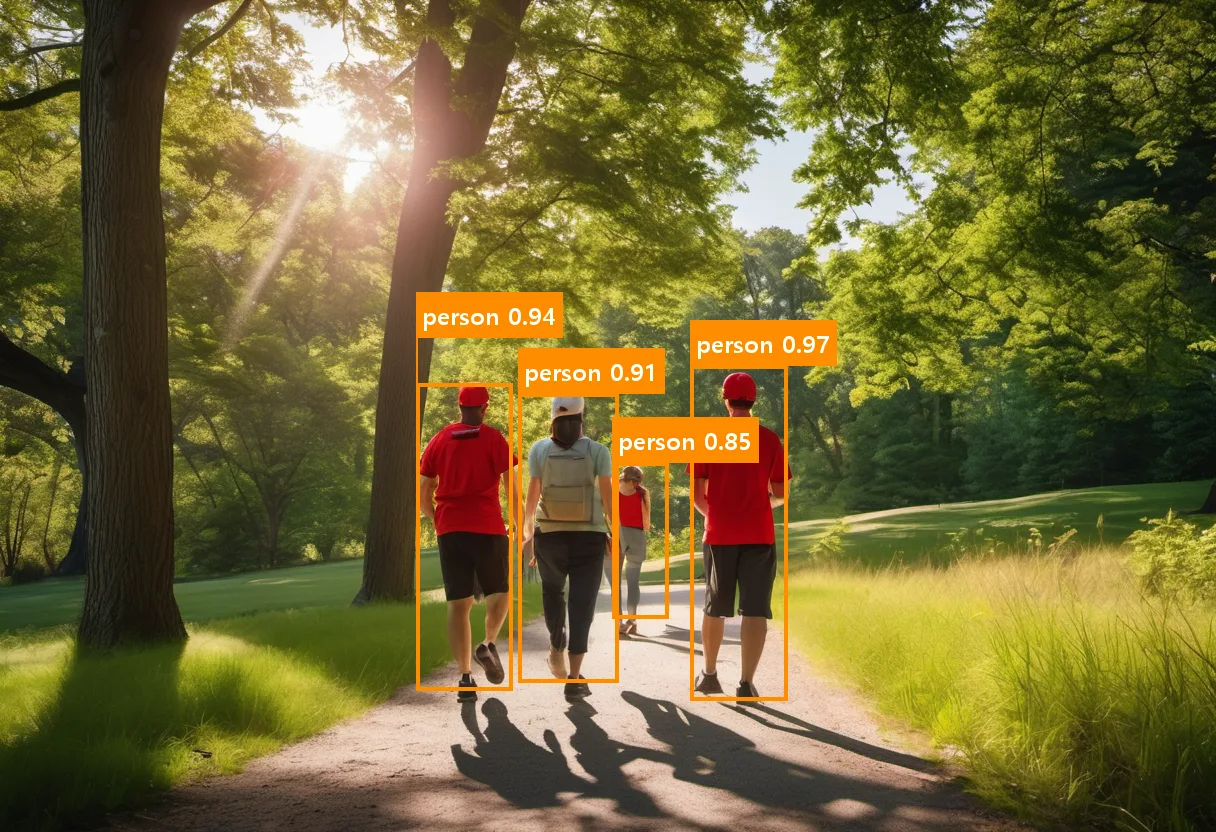
YOLO (You Only Look Once) is a family of real-time object detection models that process an image in a single forward pass to predict both an object’s location (bounding box) and its class (what it is) at once. As explained in SAM vs YOLO, YOLO is built to quickly answer “what is where.”
What “You Only Look Once” means
Unlike earlier two-stage detectors that split an image into regions and examined candidate regions sequentially, YOLO passes the entire image through the network once to predict the locations and classes of multiple objects simultaneously. This “look only once” approach is what gives it near-real-time processing speed.
Architectural changes in the latest YOLO26
Per Ultralytics’ official documentation, YOLO26 introduces the following changes over the previous generation:
- NMS-free end-to-end inference — removes the post-processing step (NMS, Non-Maximum Suppression) that deduplicates overlapping candidate boxes from the default pipeline, reducing latency and deployment complexity.
- A simplified detection head — drops the DFL (Distribution Focal Loss) component to reduce compute while maintaining localization accuracy.
- New training techniques — introduces MuSGD (an optimizer combining Muon and SGD), Progressive Loss, and STAL (Small-Target-Aware Label Assignment) to help detect small objects.
- A unified task head — supports not just detection but segmentation, pose estimation, classification, and oriented (rotated) box detection within a single architecture.
Model sizes and performance
YOLO26 ships in five scales — nano (n), small (s), medium (m), large (l), and extra-large (x) — ranging from 2.4 to 55.7 million parameters. Per Ultralytics’ official figures, it achieves 40.9–57.5 mAP on the COCO dataset, with latency of 1.7–11.8ms on a T4 GPU (TensorRT). The smallest model, YOLO26n, is reported to be up to 43% faster than the previous-generation YOLO11n on CPU (ONNX) inference.
The exact release date is stated differently across sources (documentation date vs. reporting date), so this article doesn’t commit to a specific date. For the latest version and precise release information at the time you’re reading this, check Ultralytics’ official documentation.
Where it’s used
- CCTV and in-store video analysis, real-time people/vehicle counting
- Object detection for autonomous-driving assistance systems
- Real-time defect detection and safety-equipment compliance checks on industrial sites
Limitations and caveats
- YOLO generally can’t detect classes it wasn’t trained on.
- If you need precise pixel-level boundaries, pairing it with SAM fits better than using YOLO alone.
- Licensing terms can differ across versions, so check the official repository’s license before commercial use.
Conclusion
YOLO is a model family that makes real-time object detection possible by processing an image in one pass to predict location and class simultaneously. The latest YOLO26 improves both speed and accuracy by trimming post-processing and refining its training techniques, and supports multiple tasks — segmentation, pose estimation, and more — within a single architecture beyond detection alone.