How Is Claude Code Different from ChatGPT for Coding?
Comparing Anthropic's Claude Code and OpenAI's coding agent Codex on underlying models, pricing, features, and benchmarks.
“Comparing Claude Code and ChatGPT” is actually the wrong comparison. ChatGPT is a general conversational chatbot, and the OpenAI product that actually corresponds to Claude Code is a separate coding agent called Codex. This article clears up that confusion first, then compares Claude Code and Codex on their underlying models, pricing, and features.
First: ChatGPT ≠ Codex
ChatGPT is a general-purpose chatbot you converse with on the web or in an app. You can use it to ask coding questions and copy-paste the answers, but it doesn’t natively support autonomous work like reading a codebase directly, editing files, and running commands.
OpenAI’s separate product for this kind of autonomous coding work is Codex. Like Claude Code, Codex runs from the terminal or the cloud and plans and carries out multi-file work on its own. So to answer “Claude Code vs ChatGPT” accurately, it needs to be reframed as “Claude Code vs Codex.”
Underlying models and pricing
| Item | Claude Code | Codex |
|---|---|---|
| Company | Anthropic | OpenAI |
| Underlying model | Claude Sonnet 5 / Claude Opus 5 | GPT-5.6 family (Sol recommended) |
| Individual pricing | Pro $20/month, Max $100-200/month | Free $0, Go $8, Plus $20, Pro 5x $100, Pro 20x $200 |
| Team pricing | Team, $20-25/seat/month | Business $20/user/month |
| Runtime environments | Terminal, VS Code/JetBrains, desktop app, web, mobile integration | Terminal, cloud sandbox, IDE extension |
Both companies adjust pricing frequently; the figures above summarize what several comparison outlets reported as of August 2026, and should be reconfirmed on the official pages before paying.
Feature differences
- Parallel work: Codex is reported to run multiple subtasks simultaneously in isolated cloud sandboxes. Claude Code coordinates multiple agents through an “Agent Team” approach that shares one task list and exchanges messages between agents.
- Mid-task intervention: Codex is noted for “mid-task steering” — the ability to redirect a running task without restarting it from scratch.
- Where it runs: Claude Code defaults to local execution, supporting a mode where code never leaves the user’s machine, while Codex emphasizes a cloud-centric flow of submitting work in the background and checking results later.
- Customization: Claude Code offers
CLAUDE.mdfiles plus Skills and Hooks for storing project-specific rules. - Reach across surfaces: Claude Code is notable for letting a single session continue across the terminal, IDE, desktop, web, and mobile.
Benchmarks: what’s confirmed and what isn’t
Several comparison outlets (Firecrawl, DataCamp, MorphLLM, and others) report figures comparing the two tools on independent coding benchmarks like SWE-bench and Terminal-Bench. As of this writing, though, this article deliberately avoids stating specific benchmark scores as fact, for the following reasons.
- Different outlets cite different benchmark versions and measurement dates, and some were written against earlier-generation models (like Opus 4.6).
- A common point across multiple outlets is that “the performance gap between the two tools is narrow, and benchmarks alone aren’t enough to declare a clear winner.”
- This article wasn’t able to directly access the original benchmark sources (e.g. independent leaderboards like vals.ai) to reconfirm exact figures.
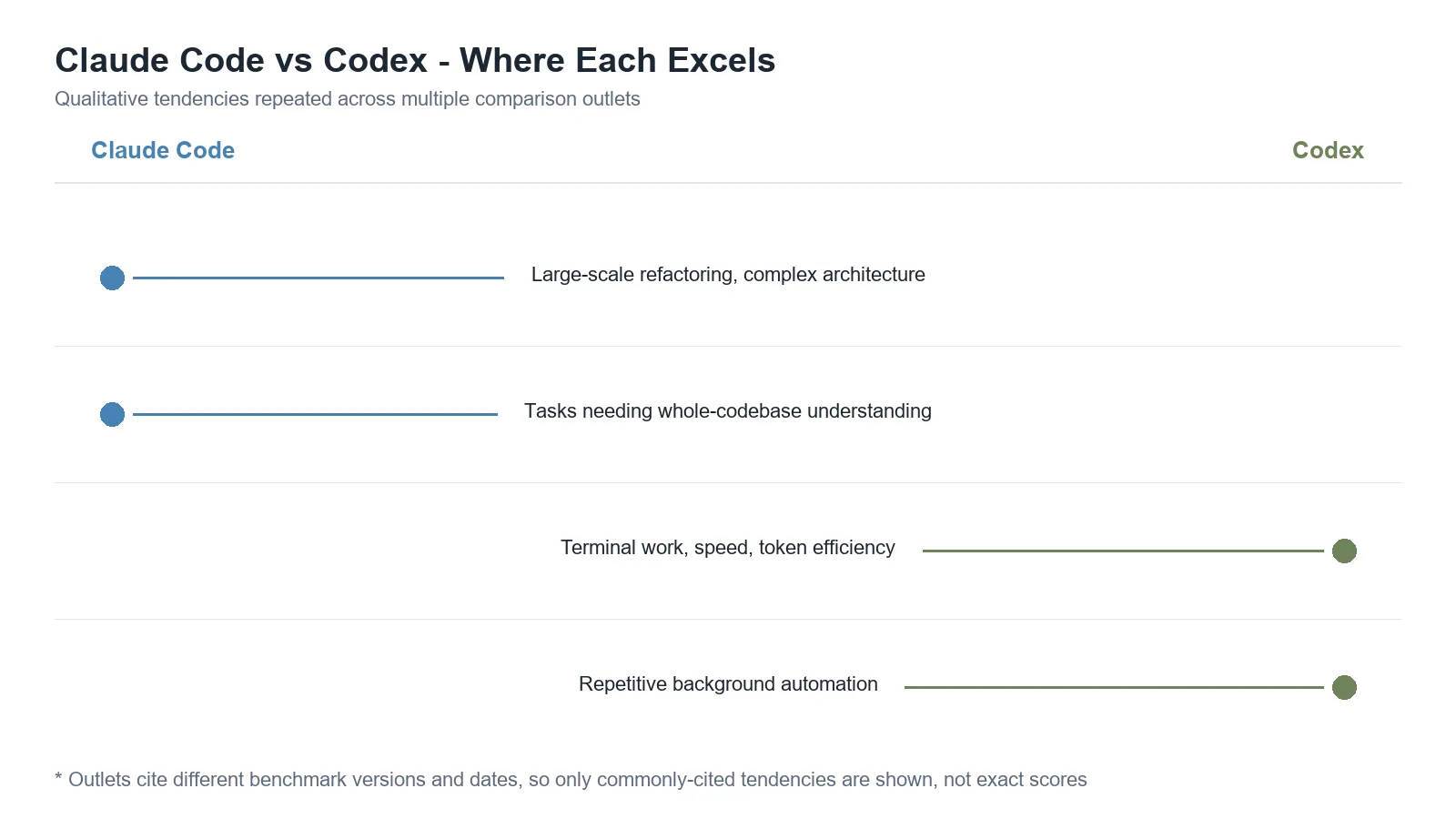
Instead, here are the qualitative tendencies repeatedly confirmed across multiple outlets.
| Area where a strength is confirmed | Claude Code | Codex |
|---|---|---|
| Large-scale refactoring, complex architecture design | Often rated ahead | — |
| Terminal work, speed, token efficiency | — | Often rated ahead |
| Repetitive background automation | — | Frequently cited as a strength |
| Tasks requiring whole-codebase understanding | Frequently cited as a strength | — |
Limitations and caveats
- The pricing and feature descriptions cited here synthesize reporting from multiple outlets, and some couldn’t be directly confirmed on official pages. Reconfirm against each company’s official documentation before adopting either tool.
- Benchmark rankings shift often as model versions change, so the “qualitative tendency” table above is a snapshot at a point in time, not a permanent conclusion.
- Both Codex and Claude Code are updated continuously, so the feature comparison here may look different a few months from now.
Conclusion
“Claude Code vs ChatGPT” only becomes an accurate comparison once reframed as “Claude Code vs Codex.” Both are agents that understand a codebase and work autonomously, but Claude Code leans toward local execution and continuity across surfaces (terminal, IDE, desktop, web), while Codex leans toward cloud-based parallelism and speed. A comparison with an IDE-based tool is covered in Claude Code vs Cursor.