What Is MCP? Why It Matters for AI Agents
An overview of MCP (Model Context Protocol), the open standard for connecting AI applications to external tools and data — its concept, structure, and origin.
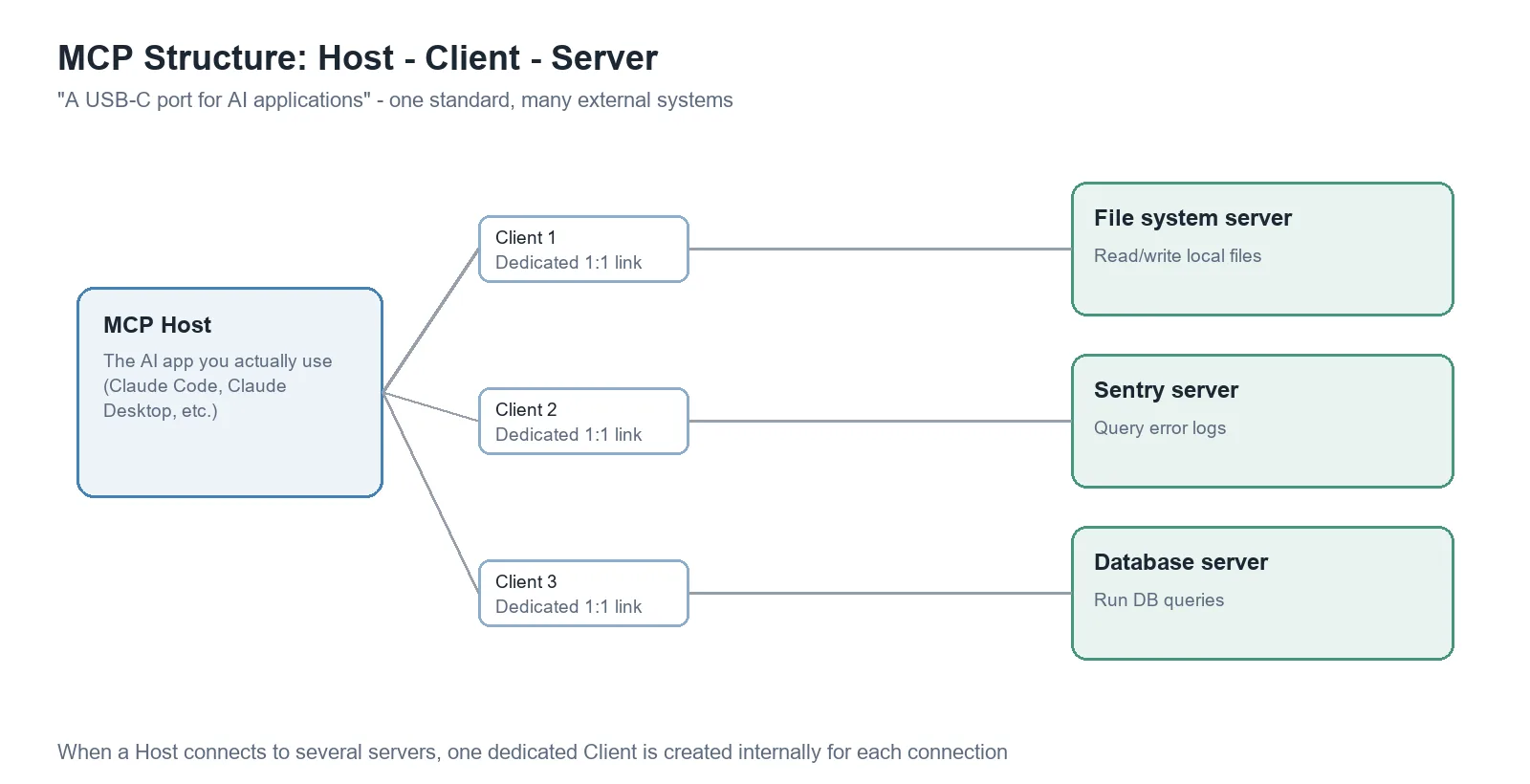
MCP (Model Context Protocol) is an open standard for how AI applications connect to external data and tools. Anthropic first open-sourced it in November 2024, and the official docs describe it as “a USB-C port for AI applications” — just as USB-C lets devices connect with one standard cable instead of a different one per device, MCP unifies how an AI connects to different external systems like calendars, databases, and internal company systems.
The problem MCP solves
Before MCP, connecting an AI application to a new external system (Slack, Google Drive, an internal database, and so on) meant writing custom integration code for that system every time. With N AI applications and M systems to integrate, that’s theoretically N×M separate integrations.
MCP reduces this by putting one shared standard between “AI applications” and “external systems.” A tool builder only needs to build to the MCP spec once, and that tool then works as-is across every MCP-supporting AI application (Claude, ChatGPT, Cursor, VS Code, and more).
Structure: Host, Client, Server
MCP has a client-server architecture built from three roles.
- MCP Host: the AI application the user actually uses. Claude Code and Claude Desktop are typical examples.
- MCP Client: a component inside the Host that handles the connection to one specific server. If a Host connects to 3 servers, 3 Clients are created internally.
- MCP Server: the program that actually provides data or functionality. It can run locally (e.g. a file-system server on your own computer) or as a remote service (e.g. the official MCP server Sentry provides).
For example, if VS Code is connected to both a Sentry MCP server and a local file-system server at the same time, VS Code (the Host) creates one dedicated Client for each, communicating with both servers independently. How to actually attach and use an MCP Server is covered in more detail in What Is an MCP Server?.
The three core primitives a server provides
An MCP server offers functionality to a Host in three forms.
| Primitive | Role | Example |
|---|---|---|
| Tools | Functions (actions) the AI can execute | Querying a database, creating a file, calling an API |
| Resources | Data that gives the AI context | File contents, DB records, API responses |
| Prompts | Reusable templates that structure an interaction | A standardized instruction for a specific task |
In other words, a single MCP server might be built to expose a database schema (Resource), provide a tool to run queries (Tool), and pre-package common query patterns as templates (Prompt).
Adoption and governance
Since Anthropic first released it, MCP has grown into something close to an industry standard. On December 9, 2025, Anthropic donated MCP to the Agentic AI Foundation (AAIF), an independent foundation under the Linux Foundation, with Anthropic, Block, and OpenAI as founding members and Google, Microsoft, AWS, Cloudflare, Bloomberg, and others joining as supporting companies. Anthropic said this was a decision made for “neutrality and openness not tied to any single company.” A wide range of AI applications and developer tools — Claude, ChatGPT, VS Code, Cursor, and more — now support MCP.
Limitations and caveats
- MCP only defines the protocol for “how an AI connects to external systems” — how the AI actually uses that information is up to each application. MCP itself doesn’t guarantee the AI’s judgment.
- Connecting an untrusted MCP server can expose you to security risks like prompt injection via external content. The official docs explicitly say to verify a server’s trustworthiness before connecting.
- The spec keeps evolving (the latest spec as of July 28, 2026 strengthened its stateless design, among other changes). It’s safer to check the current spec at the time you’re building.
Conclusion
MCP is a protocol that standardizes how AI connects to the outside world, and the “USB-C for AI applications” analogy fits precisely. Understanding the Host-Client-Server structure and the three primitives — Tools, Resources, and Prompts — covers most of what you need to grasp about MCP. It’s also worth keeping in mind that while Anthropic started it, MCP is now managed as an industry standard by multiple companies together.