SenseTime Open-Sources SenseNova-Vision, a Unified Vision Model
Chinese AI company SenseTime has open-sourced SenseNova-Vision, a single model that handles detection, segmentation, depth estimation, and 3D reconstruction.
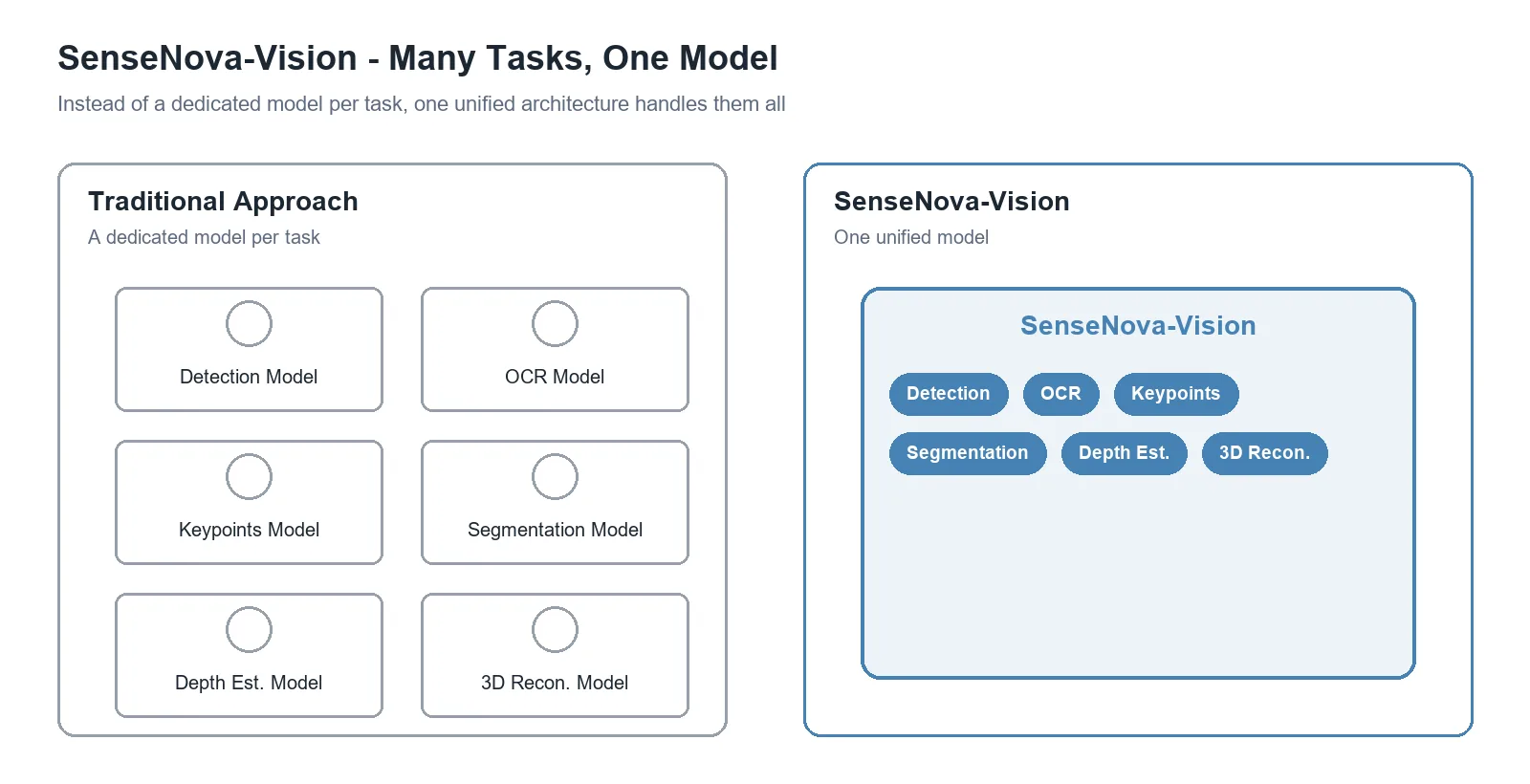
In July 2026, Chinese AI company SenseTime open-sourced SenseNova-Vision, a unified vision model that handles object detection, OCR, keypoint localization, image segmentation, depth estimation, and 3D reconstruction within a single model. Instead of using a separate specialized model per task, it’s designed to handle a range of vision tasks with one system.
How one model handles multiple tasks
SenseNova-Vision reframes different visual recognition tasks as problems of text generation, image generation, or mixed text-image generation. In other words, rather than giving each task — detection, segmentation, depth, surface-normal estimation — its own dedicated head, decoder, or loss function, it handles them all within a single generative architecture. It supports dense geometric prediction like surface-normal estimation, as well as multi-view 3D tasks like point-cloud reconstruction and camera pose estimation from multiple viewpoints.
Training data: a 50-million-sample visual instruction dataset
Alongside the model, SenseTime also released “SenseNova-Vision Corpus-50M,” a 50-million-sample visual instruction dataset. Both the model and code are open-sourced via GitHub and Hugging Face.
Note
Unlike the detection and segmentation models covered elsewhere on this site — such as in SAM vs YOLO and What Is Segment Anything Model (SAM)? — which are each specialized for a single task, SenseNova-Vision takes a different approach by attempting to handle multiple vision tasks within one unified model. For precise benchmark figures and licensing terms, check the official GitHub repository before actual deployment.