What Is NVIDIA Alpamayo? A Self-Driving AI Model That Reasons
NVIDIA's Alpamayo, unveiled at CES 2026, is an open-source autonomous-vehicle VLA model that reasons through unfamiliar driving situations instead of just reacting to them.
NVIDIA’s Alpamayo, unveiled at CES 2026, is a family of open-source models designed to let autonomous vehicles reason through unfamiliar driving situations rather than simply reacting to them. At its core is a 10-billion-parameter Vision-Language-Action (VLA) model that handles perception, language, and control in a single pipeline, released alongside simulation tools and a dataset of over 1,700 hours of driving data.
What’s different: reactive vs. reasoning
Many existing autonomous-driving perception models work more like “given this input, produce this reaction.” Alpamayo adds a reasoning step, designed to let the system interpret unusual situations — construction zones, unpredictable pedestrian behavior — and explain why it made a given decision. NVIDIA founder Jensen Huang called it “the ChatGPT moment for physical AI,” describing it as the point where machines begin to understand, reason about, and act in the real world.
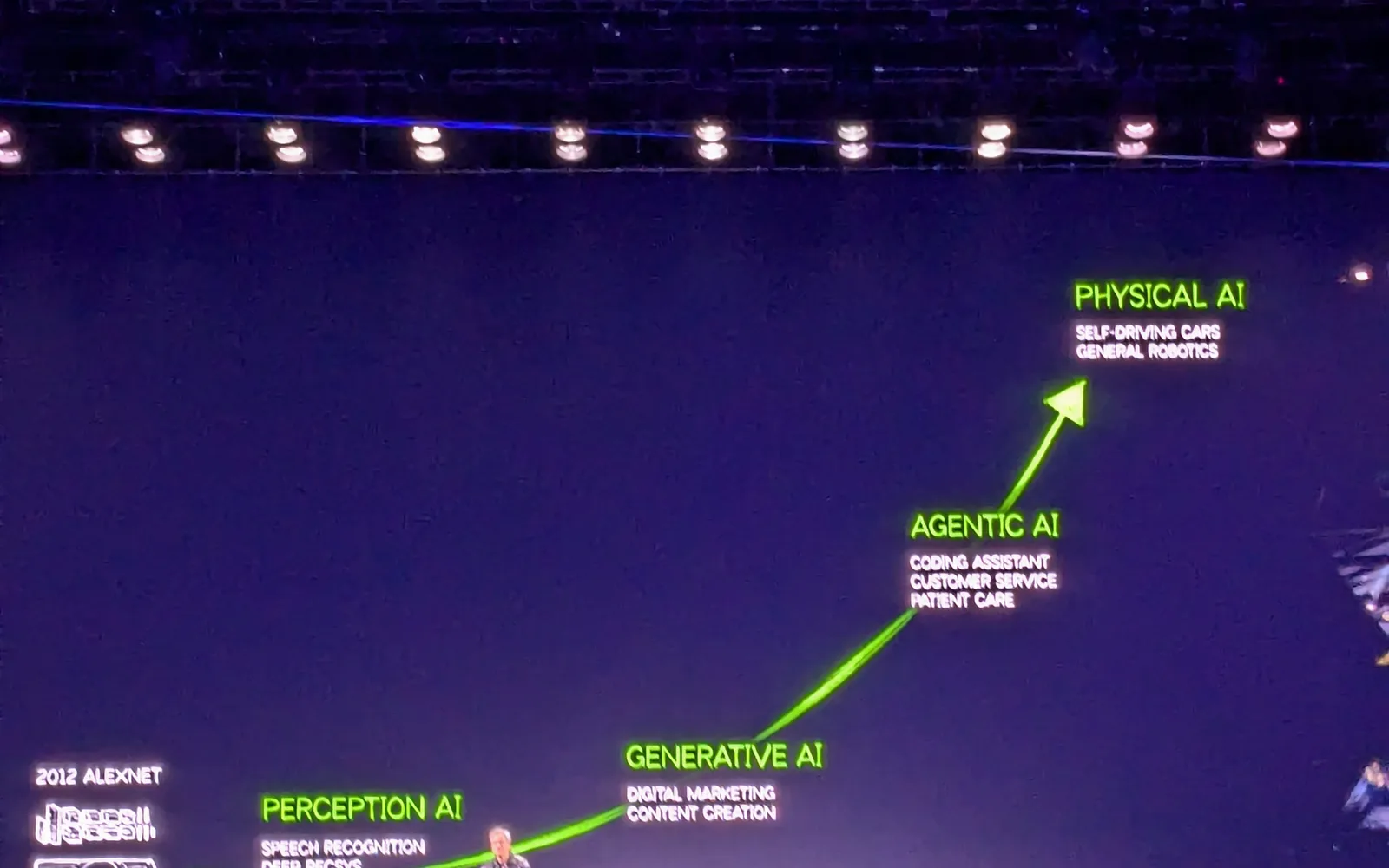
The cover photo above shows Jensen Huang presenting at CES 2025 — not the actual CES 2026 scene where Alpamayo was unveiled. The roadmap on the slide, though, “Physical AI: self-driving cars and general robotics,” connects directly to the story covered in this article.
Components
| Component | Description |
|---|---|
| Core model | A 10-billion-parameter VLA (Vision-Language-Action) model handling perception, language, and control end-to-end |
| AlpaSim | An open-source simulation framework for validating autonomous-driving systems |
| Driving dataset | Over 1,700 hours of curated driving data from a range of regions and conditions, used for explainability and safety validation |
Why it matters
What stands out about Alpamayo is that it comes directly from NVIDIA rather than an automaker — an open-source foundation that carmakers without the resources to build a full autonomous-driving stack from scratch can build on to move faster. Much like Gemini Robotics 2 for robot control, it’s another sign of a pattern where a small number of intelligence suppliers sit underneath many different hardware makers, this time in autonomous driving.
Limitations and caveats
- Alpamayo was unveiled at CES in January 2026; how widely it has since been adopted in actual production vehicles hasn’t been independently confirmed as of this writing.
- The idea of “reasoning-based” autonomous driving isn’t yet an established industry standard — this description is based on NVIDIA’s own announcement.
- Since autonomous-driving technology is directly tied to safety, actual adoption details and performance figures are best confirmed through each automaker’s own official statements.
Conclusion
Alpamayo is an attempt to move autonomous-driving AI from “a system that reacts to fixed rules” toward “a system that reasons and explains.” Since NVIDIA released it as open source, the interesting question going forward is whether automakers without the resources for in-house development can use it to close the gap in autonomous-driving capability.