RAG vs Fine-tuning: When Should You Use Which?
Comparing RAG and fine-tuning, the two main ways to adapt an LLM for a specific purpose, and which situations each fits.
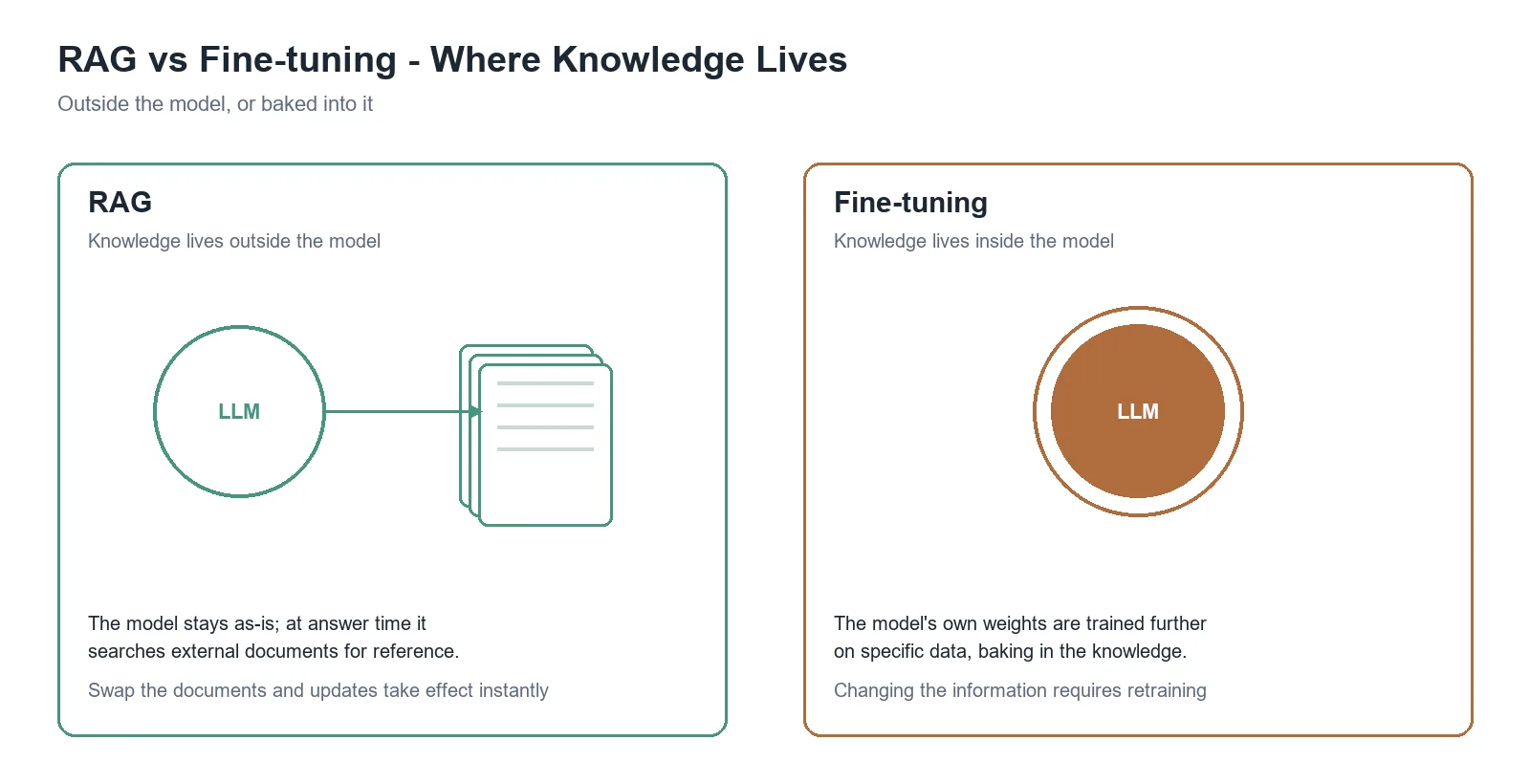
RAG leaves the model as-is and has it search external documents for reference at answer time, while fine-tuning trains the model itself further on specific data, baking knowledge or a tone of voice into the model. Both aim to “adapt an LLM to your use case,” but the underlying approaches are fundamentally different.
The core difference
| RAG | Fine-tuning | |
|---|---|---|
| Where knowledge lives | Outside the model (external document store) | Inside the model (weights) |
| Updating information | Immediate — just swap the documents | Requires retraining to take effect |
| Skills needed | Mainly retrieval and architecture | Broad skills: NLP, deep learning, data prep, evaluation |
| Reducing hallucination | Effective, since answers are grounded in real documents | Still vulnerable on anything the model wasn’t trained on |
| Good fit | Reflecting real-time, up-to-date information | Consistently reflecting a domain’s tone or expertise |
When RAG fits
- Information changes frequently (breaking news, inventory levels, policy changes, etc.)
- Freshness matters and hallucination needs to be minimized
- You lack the resources (data, GPUs, specialized staff) to retrain a model
When fine-tuning fits
- You need consistent understanding of a specific domain’s terminology and nuance
- Response format or tone needs to be standardized (e.g. a specific brand voice)
- The same type of task needs to be performed repeatedly with very high accuracy
Do you have to pick just one
Not necessarily. A hybrid approach — first fine-tuning a model on domain-specific data, then layering RAG on top — is common in practice, aiming for both domain expertise and up-to-date information at once. A generally sensible order is to try RAG first, since it’s less complex to implement, and consider adding fine-tuning only if something’s still missing (tone, domain expertise).
Limitations and caveats
- Neither method is a silver bullet. RAG depends on retrieval quality, while fine-tuning depends heavily on the quality and volume of training data.
- Fine-tuning means retraining a deep learning model’s weights, so it requires far more compute resources and expertise than RAG.
- There’s no rule that “one is always better” — it depends on your purpose and available resources.
Conclusion
RAG is a way to “attach up-to-date information from outside the model,” and fine-tuning is a way to “bake knowledge into the model itself.” If information changes often and you want to minimize implementation overhead, RAG fits; if you need deeply specialized, consistent responses in a specific domain, fine-tuning fits — and using both together when needed is also a perfectly reasonable choice.