What Is Agentic AI? How Is It Different from an AI Agent?
How the terms Agentic AI and AI Agent are actually used differently in practice, and why the distinction matters.
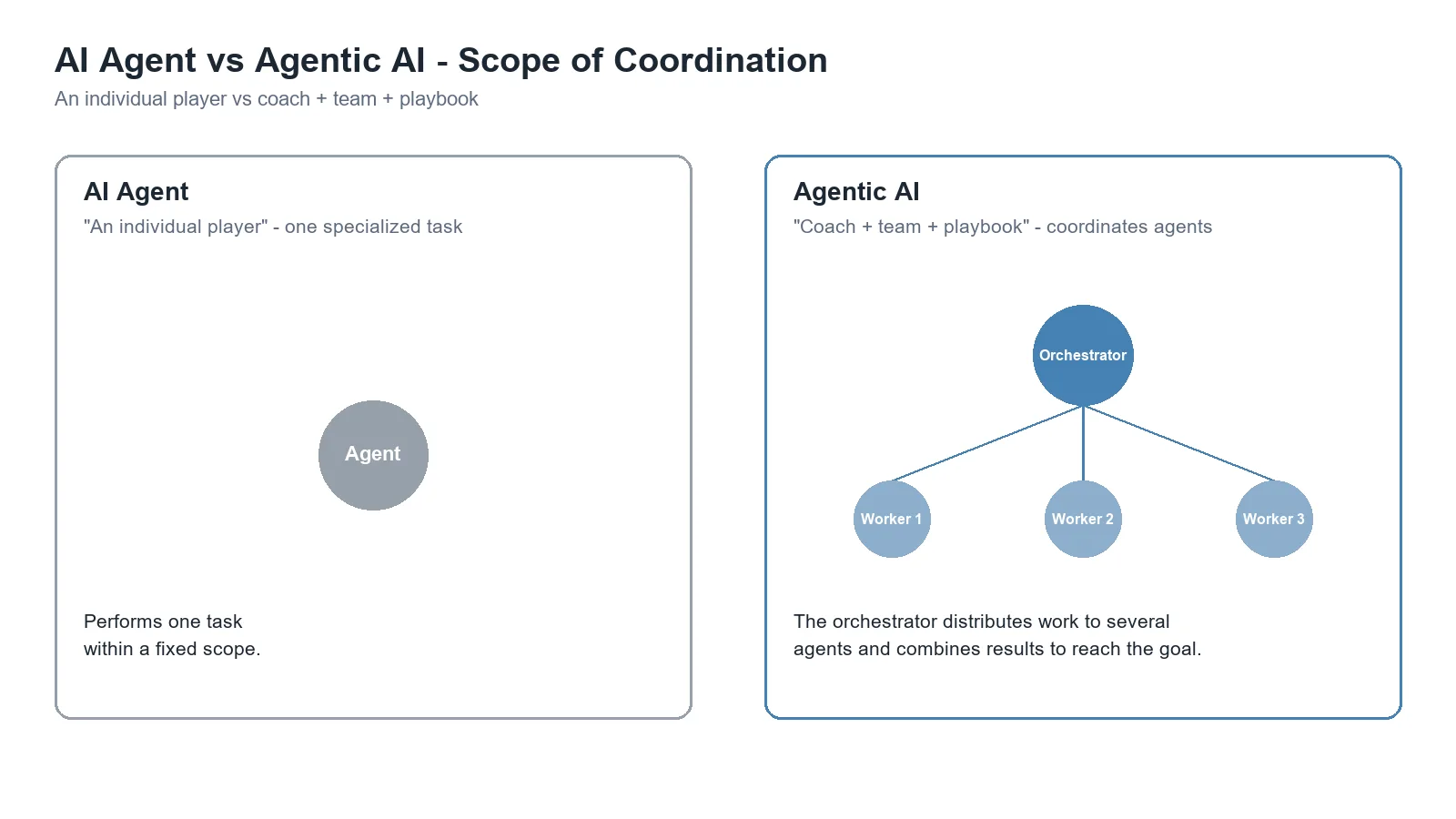
“AI Agent” and “Agentic AI” are often used interchangeably, but the industry generally treats them as concepts of different scope. Where an AI Agent is an individual unit that performs a specific task, Agentic AI is closer to a higher-level system that coordinates multiple agents and tools to achieve a larger goal.
Understanding it through a sports analogy
The IT trade publication CIO explains the difference with a sports analogy: if an AI Agent is “an individual player,” Agentic AI is “the coach, the team, and the playbook all working together.” One expert defined Agentic AI as “a system that supervises and coordinates multiple agents to achieve a broader goal.”
Unpacking that analogy:
| AI Agent | Agentic AI | |
|---|---|---|
| Scope | A specialized tool for a specific organizational function | A higher-level system coordinating multiple agents and tools |
| Predictability | Narrow scope, relatively predictable outcomes | Sets its own goals and reasons across multiple domains |
| Learning/adaptation | Limited | Includes continuous learning, self-reflection, and goal readjustment |
| Analogy | An individual player | The coach + team + playbook as a whole |
The connection from Anthropic’s perspective
As covered in What Is an AI Agent?, Anthropic defines an agent as “a system where the LLM directs its own process and tool usage.” Agentic AI often refers to a larger structure where multiple individual agents like this cooperate with each other, or where a higher-level agent distributes work to sub-agents — an orchestrator-workers pattern. In other words, “Agentic AI” isn’t so much a new technology as an expression that emphasizes agentic traits — autonomous judgment, tool use, and multi-step execution.
Why this distinction matters in practice
CIO’s analysis points out why this distinction matters to practitioners: many products that are really just “a chatbot with RAG bolted on” or a simple workflow tool get marketed as an “agent” or “agentic AI.” This confusion can lead to paying for more than the product actually delivers.
Also, as autonomy increases, so does the complexity and risk of coordination. Connecting multiple agents via a protocol like MCP is convenient, but it also multiplies the paths through which data could be exposed. For this reason, practitioners are generally advised to start with a limited scope — read-only or suggest-only modes — and gradually increase autonomy from there.
Limitations and caveats
- The distinction between “AI Agent” and “Agentic AI” isn’t yet a standard the entire industry has agreed on. This article summarizes a relatively widely cited way of drawing the line; some literature and companies use the two terms essentially interchangeably.
- Whether the word “agentic” in a product’s marketing accurately reflects its actual level of autonomy is a separate question worth checking.
Conclusion
If an AI Agent answers “what can it do,” Agentic AI answers “how do multiple agents work together to achieve a larger goal.” Using the two terms precisely makes it easier to judge, when evaluating a product or system, whether it’s a tool that performs a single task or a system that coordinates multiple tasks on its own.