Berkeley Lab Cuts X-ray/Neutron Imaging Analysis from a Month to 15 Minutes with SAM 3 and DINOv3
The Department of Energy's Berkeley Lab is running the SYNAPS-I project, using Meta's open-source vision models SAM 3 and DINOv3 to dramatically speed up beamline scientific imaging analysis.
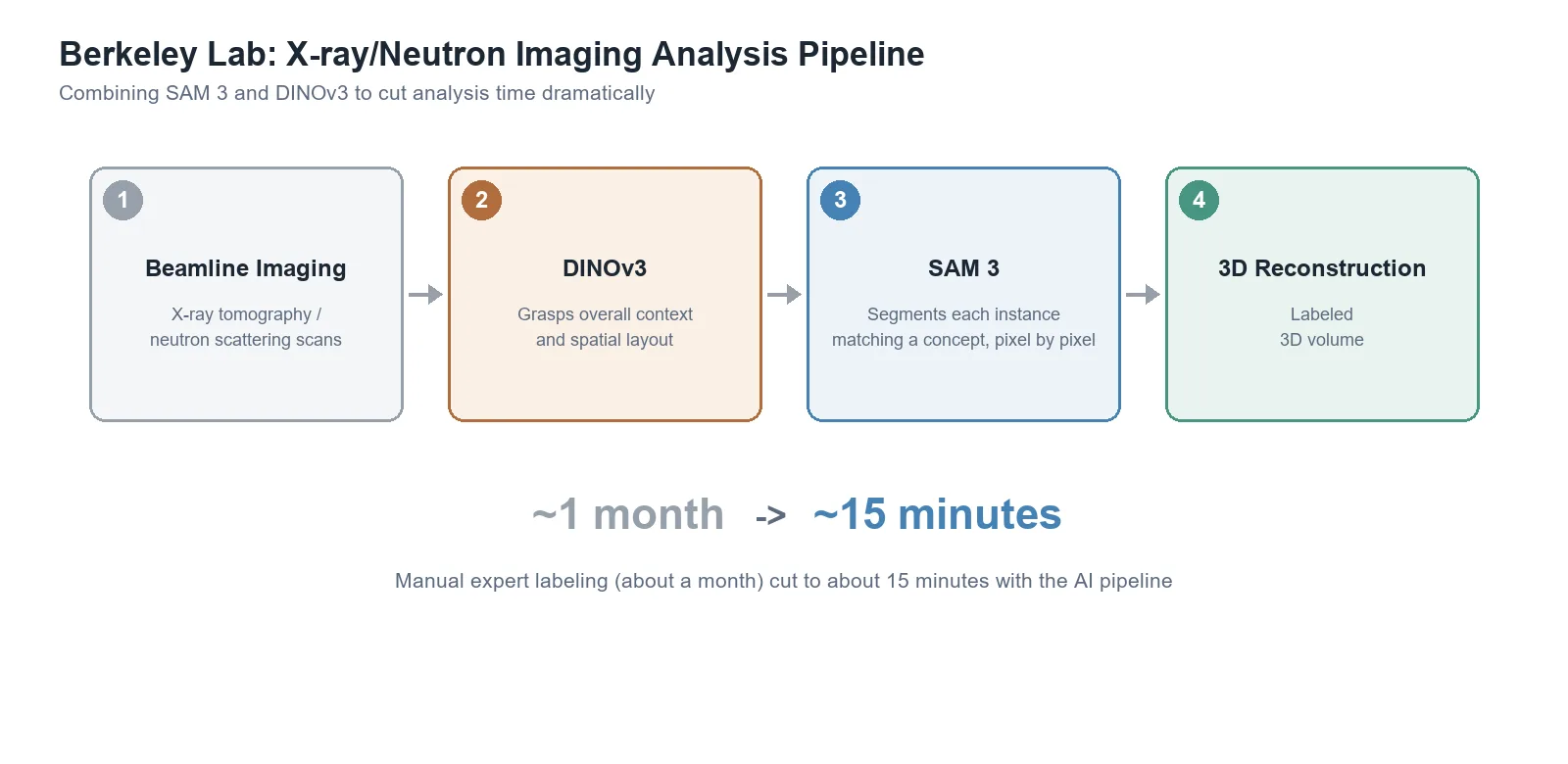
The U.S. Department of Energy’s Lawrence Berkeley National Laboratory (Berkeley Lab) has deployed Meta’s open-source vision models SAM 3 (SAM3) and DINOv3 across 300 A100 GPUs, cutting the time to analyze X-ray and neutron beamline imagery from a month down to about 15 minutes. This work is part of SYNAPS-I (SYnergistic Neutron And Photon Science–Intelligence), a multi-institution project led by Berkeley Lab.
What role each model plays
The two models are combined into a complementary pipeline. DINOv3, a self-supervised vision model, first grasps the overall context of the scan — what’s in it and roughly where. SAM 3 then draws a precise pixel-level boundary around each individual instance matching the target concept. The architectural difference between SAM and SAM 3 is covered in detail in What Is Segment Anything Model (SAM)?
The SYNAPS-I project
SYNAPS-I is led by Berkeley Lab senior scientist Alexander Hexemer, with participation from U.S. national laboratories including Argonne, Brookhaven, Oak Ridge, and SLAC. The team fine-tuned both models — originally trained on natural images — for scientific imaging data of a completely different character, like X-ray tomography and neutron scattering. For example, they used the models to reconstruct 3D volumes of grapevine stems from micro-CT scans captured at Berkeley Lab’s Advanced Light Source (ALS) beamline, automatically identifying the xylem tissue that carries water.
Why it matters
An analysis process that previously required roughly a month of manual expert labeling has been cut to about 15 minutes through this pipeline, from data acquisition to a meaningfully labeled 3D volume reconstruction. This can be seen as an example of solving the data-analysis bottleneck in scientific research by adapting general-purpose open-source vision models to a specific domain.
Note
This project was introduced as one of the early projects under the DOE’s “Genesis Mission,” which began in late 2025. Precise throughput figures, team size, and other details may continue to be updated, so it’s worth checking Meta AI’s official announcement for the latest.