Anthropic Adds a Watermark to Claude Text in Response to the EU AI Act
In response to the EU AI Act's transparency rules, Anthropic has begun applying an invisible watermark to text generated by Claude, worldwide.
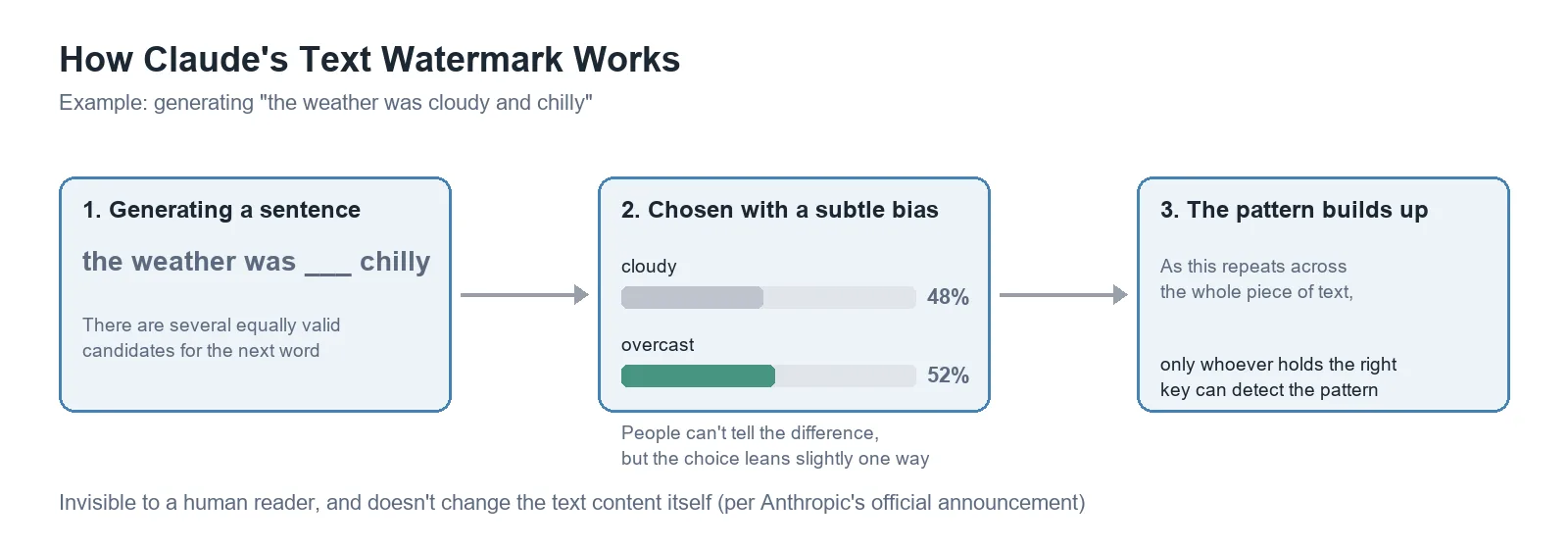
In August 2026, in response to the transparency requirements of the EU AI Act (Article 50), Anthropic began applying an invisible watermark to text generated by Claude, worldwide. It’s applied with no opt-out, and separately from the watermark, files also carry provenance metadata based on the C2PA standard.
How the watermark works
According to Anthropic’s official announcement, the watermark uses SynthID-Text, a method developed by Google DeepMind. Rather than visibly altering the text content, it introduces a subtle bias into the pattern of choices Claude makes among equally valid words (for example, choosing “overcast” instead of “cloudy” in “the weather was cloudy and chilly”). A human reader can’t tell the difference, but whoever holds the right key can detect it. Anthropic has stated that this watermarking “does not affect the quality of Claude’s output.”
Relationship to the EU AI Act
Anthropic is one of roughly 190 companies that signed the EU AI Act’s “Code of Practice on Transparency for AI-Generated Content.” Complying with this Code of Practice grants a presumption of compliance with the Article 50 requirements. Article 50’s transparency obligations took effect on August 2, 2026, and non-compliance can carry fines of up to €15 million or 3% of global annual revenue, whichever is greater.
Limitations
Anthropic noted that the watermark is less effective on content with a clearly correct answer, like fact-checking, or on text that’s only lightly edited, since there’s little room to choose among words — and that reliability is also lower on very short text. It also stated that the watermark can be lost if the file is converted to a different format, re-saved, or screenshotted. Models predating August 2, 2026 will get watermarking added progressively through December 2, 2026 (before the EU’s legacy-system grace period expires).
Note
Some users have raised concerns — for instance, that their own hand-written text could be mistaken for AI-generated content, or that technical implementation details are lacking. Since watermarking technology and policy can keep changing, it’s worth checking Anthropic’s official announcement directly for the latest details.